
US green finance to put ‘ducks in a row’ for Trump exit

© 2026 GlobalCapital, Derivia Intelligence Limited, company number 15235970, 161 Farringdon Rd, London EC1R 3AL. All rights reserved.

Accessibility | Terms of Use | Privacy Policy | Modern Slavery Statement | Event Participant Terms & Conditions | Cookies

US green finance to put ‘ducks in a row’ for Trump exit
Lubber_230x150
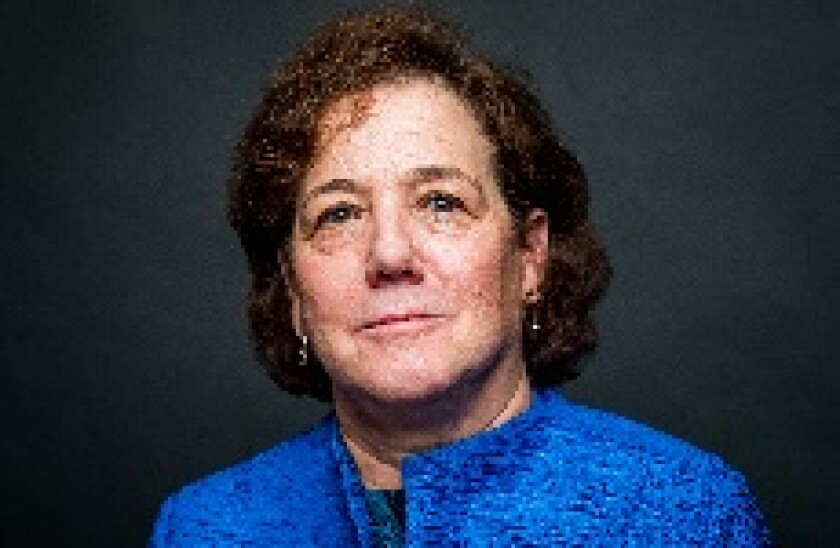
Mindy Lubber from Ceres at Skoll World Forum 2017

US regulators are taking slow steps towards accepting that climate change is a financial risk, but progress is being made. Appointments have been made to a CFTC committee created to better understand climate-related market risks and one of the members is Mindy Lubber, chief executive of sustainability organisation Ceres. She told GlobalCapital her organisation is working to prepare for a new, green-minded president.

Ceres wants companies, investors and the financial system to consider climate change a big risk. It provides evidence of climate change to investors and authorities.

The organisation’s strategy involves engaging with and meeting regulatory officials, collaborating with investors, and briefing members of US Congress.

Although, the argument runs, the Securities and Exchange Commission has a responsibility to make sure investors have adequate information on risks including climate change, and the Federal Reserve System has to consider what it might mean for the broader monetary and financial system, it is the Commodity Futures Trading Commission (CFTC) that has created the first ever committee at federal advisory level focused on addressing the issue.

It will consider the risks of climate change to capital markets and the broader economy. Lubber is one of 35 finance industry, corporate, government and non-profit experts picked for the Climate-Related Market Risk Subcommittee of the CFTC’s Market Risk Advisory Committee.

The sub-committee is set to produce a public report with recommendations to financial regulators on mitigating climate change risks. This may look at how investors and firms can better integrate scenario analysis and governance initiatives into risk assessments and reports. It is also expected to suggest policy solutions for climate risk management and disclosure.

“It’s early stages, so I can’t say a lot, because I don’t know a lot,” said Lubber. “Their mandate is to look across the financial system at the risk. Beyond that, it’s where the committee takes it and what it looks like.”

Lubber_650
Mindy Lubber
source: Ceres

San Fran leads

Initiatives like the committee have been a long time coming.

“In fact, 15 or 16 years ago, when we started talking about climate risk as a financial risk, not unlike other financial risks, I would say people perhaps thought that was just crazy,” said Lubber. “We have come a long way.”

But there are the signs of a shift now, in spite of US president Donald Trump’s administration being opposed to many efforts to slow climate change.

As for why the CFTC might have decided to set up the committee now, Lubber suggests as potential reasons the obviousness of the financial risk of climate change: for example, with the fall of Californian utility company PG&E because of its liability for wildfire damage; progress in the UK, where Bank of England governor Mark Carney is seen as a pioneer on the topic; and the work of the Federal Reserve Bank of San Francisco.

The San Francisco Fed has been outspoken on climate change, and on November 8 hosted a conference on climate change economics, the same week as the US started the process of withdrawing from the Paris climate accords. 

Veena Ramani, senior programme director, capital market systems at Ceres, described the bank’s approach as: “very baby steps right now”. 

She added: “They are approaching it from a ‘let’s inform ourselves what are the potential impacts of climate change on community development, on economic stability’ [perspective], but some of the signals are really interesting.”

At the conference, Lael Brainard, a member of the board of governors of the Federal Reserve System, said: “To fulfil our core responsibilities, it will be important for the Federal Reserve to study the implications of climate change for the economy and the financial system and to adapt our work accordingly.”

She also said that the Fed is having discussions about participating in the Central Banks’ and Supervisors’ Network for Greening the Financial System, a forum many of the Fed’s counterparts have already joined.

“There’s interesting research and focus on this issue happening very, very quietly in the regional banks of the Federal Reserve System,” said Ramani. “The goal of our efforts is to give them all the ammunition that they need to take this somewhat under-the-radar work that’s happening to have it be a focused initiative.”

Readying for post-Trump

The presidential election in November 2020 could prove a tipping point, especially if the victor comes from the Democratic Party. Leading candidates support a Green New Deal, a programme of economic reform based around reducing carbon emissions. The election of such a candidate would probably lead financial regulators and supervisors to focus on climate change more, too.

Ceres’s work would feed into that effort.

“This is the start of a process,” said Lubber. “I don’t have a crystal ball [about who will win in the election]. You’ve got to be ready. If there’s a change in administration, that’s a mere year and a couple of months away. This is building a record, it’s doing the research, it’s bringing the best minds in the world together, it’s thinking it through.”

Lubber noted that regulatory initiatives take time, however. And regulatory change would not occur in sync with the presidential cycle. For example, the commissioners at both the SEC and the CFTC have staggered terms, and at each body no more than three commissioners can belong to the same political party.

Still, for green finance advocates this is even more reason to get on with preparation.

“Our goal is to get our ducks in a row over the next few months,” said Ramani. She said this involved finalising a vision for the role for financial regulators to play on climate change, engaging with oversight bodies in Congress and organising a coalition. This is “so that, should there be a change in administration, we are all set to go”.

Gift this article