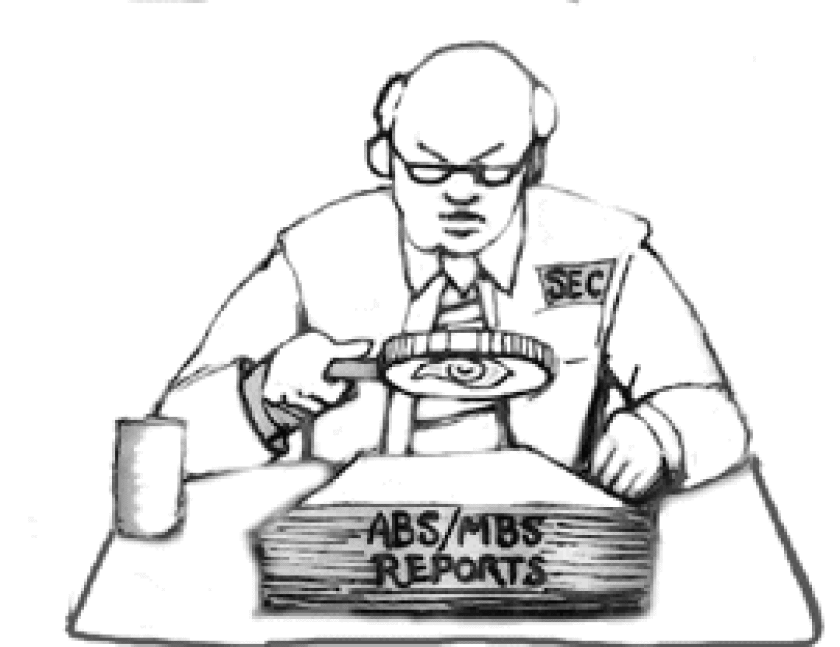
The Securities and Exchange Commission is planning to become more active in regulating and monitoring structured finance issuers, starting with the upcoming reporting season that will see many issuers file 10Ks in the coming months, according to a staff member. Two issues are in the hopper: the SEC will be checking to ensure that issuers file Sarbanes-Oxley releases and submit their reports under the correct filing numbers. It is also working on a written framework specifically for structured finance issuers, which would be the first of its kind. The SEC says it is taking a more-aggressive approach because it found that roughly 50% of the 10K filings by issuers last year were incorrect in some way.
"The SEC is going to be watching you like a hawk," says one lawyer, referring to issuers. He suggests they perform filing audits of the asset-backed entities from which they issue to make sure they do not run afoul of the SEC when they file their annual reports. "If they pull a 10K in April and don't find a Sarbanes-Oxley release, that issuer runs a serious risk of being put in the penalty box," says one lawyer.
Structured finance issuers, although technically only shell companies, are required to file quarterly and annual reports under the Securities and Exchange Act of 1934. The SEC has never come out with specific reporting guidelines for asset-backed issuers. Instead, what guidelines do exist have evolved from a series of no action letters. But, this loose code means asset-backed issuers tend to report to the lowest-common denominator and usually only file trustee reports, which are widely available to the market and provide little insight. "This is because there is a lack of guidance in this space from us," according to the SEC staff member, who says it is coming up with a new framework now that Sarbanes-Oxley has been digested.
"Clearer standards are needed so that everyone understands the minimum. If there's certain basic information that you can't supply, you shouldn't issue," says Myron Glucksman, a securitization consultant and former managing director in the ABS group at Citigroup Global Markets. Glucksman, who says he contributed testimony as part of the SEC's last rulemaking initiative for the securitization market in 1992, adds that he welcomes the initiative as one that will be good for the long-term health of the market.
Others warn the guidelines will be more restrictive than the current practice. And, they caution that the enhanced monitoring could put issuers in a precarious situation if, in a worst-case scenario, the SEC forces them to pull a shelf registration because of reporting errors. This could in turn create funding shortfalls for companies that rely on the capital markets and at the very least create a black eye, according to industry observers.
 |
| Ed Gainor |
"The rules will be different and probably more restrictive than current practice. ABS issuers and underwriters both need to be sensitive to this and need to comply," says Ed Gainor, a partner at McKee Nelson.