Free content
-
GlobalCapital asked loan market participants for their votes for the Syndicated Loan, Leveraged Finance and Private Placement Awards 2016, in November.
-
 Investment grade loan pricing has stopped falling — meaning the flow of refinancing deals is ebbing. Mergers and acquisitions, as ever, are what banks want, and they are confident of getting more in 2016. But will banks finally get round to weeding out unprofitable relationships? Rob Cooke reports.
 -
Middle Eastern loans burst open in the fourth quarter of 2015, with deals aplenty for corporates, banks and sovereigns. The deal flow will not ebb this year, but pricing will rise and international lenders will play a bigger role, replacing local lenders. Elly Whittaker reports.
-
2015 was meant to be the year that direct lenders conquered all before them, as banks’ retreat from mid-market lending became a rout. But the opposite has happened. Despite the enormous weight of money pouring into funds, banks are still there, and funds are having to deal with it. Ross Lancaster reports.
-
For CEEMEA bonds, 2015 was largely a disappointing year. Political issues affected many of the region’s biggest bond issuers, while falling oil prices made bond issuance difficult for several others and the threat of a hiccup from US Federal Reserve rate rises loomed ever large. There were brief windows of opportunity, but to use those windows last year’s borrowers in the CEEMEA region — and their lead managers — needed to be nimbler, more decisive and smarter than usual to get successful deals away.
-
After three consecutive years of record volumes, in 2015 Latin American bond market momentum was halted by crises in Brazil and plunging commodity prices. Though volatility will continue and issuers and investors often struggle to meet on price, the market looks mature enough for a modest recovery in 2016. Oliver West reports.
-
IPO, rights issue and equity-linked volume were all down in 2015, so the fact that block trades maintained their 2014 level of issuance made them the stand-out business of the year in equity capital markets. Now stocks participants are asking themselves if they can keep up the pace. Olivier Holmey reports.
-
Investors see equity-linked debt as combining safety with upside in a happy medium. But for issuers, the product is offering happy extremes: super-high premiums, ultra-low coupons and even no equity risk. Jon Hay reports.
-
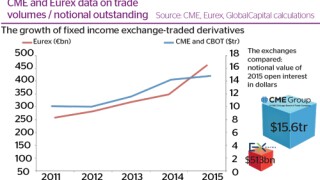
Competition between derivatives exchanges is intensifying, giving rise to a rash of product and platform launches in 2015, as well as geographical expansion. But 2016 will be dominated by regulatory deadlines for electronic trading. As Dan Alderson reports, exchanges that best prepare market participants to meet these requirements will be the ones that will win out.
-
2015 will be remembered as a year when volatility returned to financial markets. With strong technical buffers to the trading range of US and European equity markets going into 2016, short volatility strategies look set to be compelling money earners in the year ahead, writes Andrew Barber.
-
We entrust our precious working capital to banks; they finance our dreams and provide revolving credit to get us through our nightmares.
-
After the second half of last year proved a real headache for primary issuance, participants in the European IPO market are readying themselves to brave markets that could be just as choppy in the first half of 2016. As Olivier Holmey reports, some of 2015’s innovations are likely to become widespread.