Free content
-
The U.K. structured products industry has been given a major boost by its regulator, the Financial Services Authority, after it issued a paper paving the way for onshore hedge funds to be sold via a UCITS wrapper.
-
HSBC is studying whether to establish an equity derivatives presence in Japan next year, following a major equities push in other markets.
-
Rory Hill, single stock equity derivatives trader at JPMorgan in London, has left the firm.
-
Lehman Brothers is recommending traditional long-only credit investors, who have shied away from using credit-default swaps, consider doing so now to lock in high-grade corporate bond profits as bonus season and year-end approaches.
-
JPMorgan has launched the first tradable index linked to Asian regional currencies and plans to structure products referenced to the instrument.
-
Merrill Lynch is extending its capital structured arbitrage research coverage to Japan, which it believes is one of the first in the market.
-
Morley Fund Management and Barclays Capital have structured a 20-year investment fund, which they will offer to retail investors in the form of a medium-term note.
-
The Royal Bank of Canada has re-established an office in Hong Kong to market foreign exchange and equity derivatives.
-
The Financial Markets Lawyers Group, an advisory group backed by the Federal Reserve Bank of New York, plans to examine the implications of an Australian court case on U.S. derivatives law after the U.K. regulator expressed concern.
-
 The Belgian regulator is putting domestic institutions at a disadvantage by not implementing a recent European Union directive.
 -
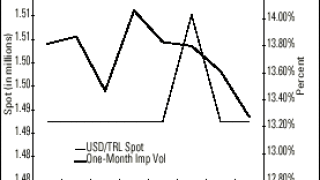
Options on the U.S. dollar and Turkish Lira currency pair sold off across the one- to three- month portion of the curve last week, following the publication of the European Union's report into Turkey's accession to the union.
-
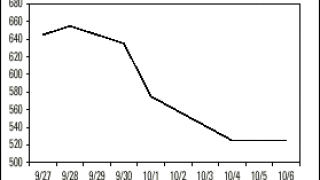
Credit-default swap spreads on Rhodia, a French chemicals company, came in 50 basis points to 525bps last week after takeover rumors triggered a flurry of protection holders unwinding their positions, according to traders.