Top Section/Ad
Top Section/Ad
Most recent


◆ Supranationals and agencies prepare to achieve the previously unthinkable ◆ Leveraged loans versus private credit and their effect on CLOs ◆ A new dawn for dollar covered bonds and UK equity market structure

Bot claims funding is ‘cheaper than peers who borrow from independent banks or credit funds’

Ferrero International markets €300m deal

Margins widen as lenders weigh up AI disruption to portfolio companies
More articles/Ad
More articles/Ad
More articles
-
 The Schuldschein market attracts an increasingly international clientele. A host of foreign borrowers has been paying trips to this once clubby German market to enjoy a pleasant cocktail of light documentation, cheap funding and a deep pool of investors — many of which are also international. Silas Brown reports.
 -
Foreign investors flocking to the Schuldschein market are drawing in issuers and forcing margins lower. As demand from overseas drives the swelling supply, Silas Brown asks: will the market be able to preserve its traditional strengths as it accommodates new investors?
-
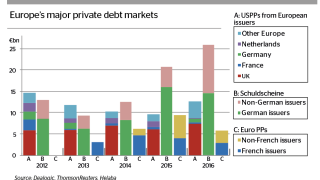
Schuldschein issuance surged to a record high in 2016, as issuers and investors from across the world flocked to a private market with deep pools of investors, flexible formats and straightforward documentation. With the variety of issuers growing all the time, the Schuldschein is fast becoming Europe’s defining private placement product, writes Silas Brown.
-
The attraction for companies of having some private debt that is neither loan nor public bond is now well established — but the market that is reaping much of the deal flow from that trend is the Schuldschein. New investors are flocking to it, and so are issuers, even though bank loans are freely available to many.
-
Europe’s Capital Markets Union project was supposed to place a regulatory rocket underneath the region’s private debt markets. But it has been slow work so far. What are the next steps for official support of the asset class? Owen Sanderson reports.
-
The widely admired US private placement market has inspired the development and growth of private debt markets in Europe. But hopes of replicating in Europe the US model, governed by regulation and convention, of a single market with one set of documents, have been pushed back. As Jon Hay reports, the market now looks headed towards a more varied ecosystem.