
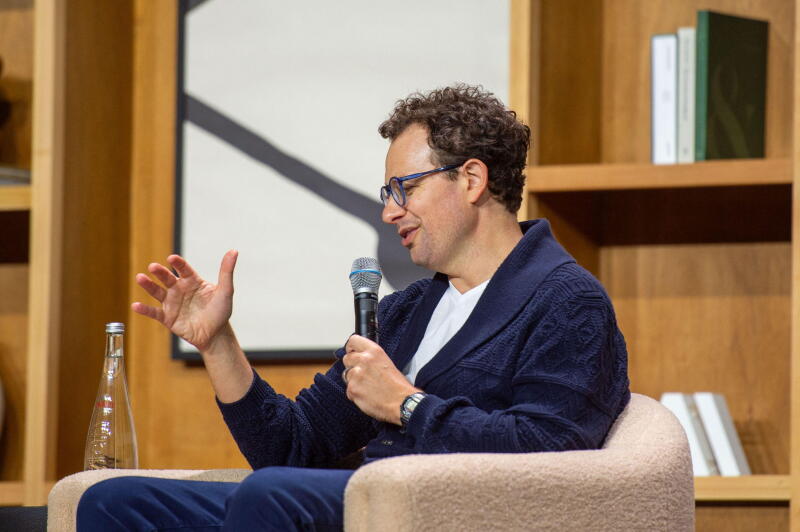
Earlier this week, Anthropic chief executive Dario Amodei issued a public call for the pace of artificial intelligence development to be slowed down to allow risk prevention time to catch up. Fellow AI zealots Sam Altman of OpenAI and Elon Musk of Tesla were quick to voice their agreement.
On the face of it, it seems these 21st century Robert Oppenheimers have woken up to the fact that their technological breakthroughs could spell the end of humanity.
Of course, fears of apocalyptic change are nothing new. In the early 19th century, William Blake rallied against the Industrial Revolution’s “dark satanic mills” that blighted “England’s green pleasant land”.
As with steam-and-iron industrialisation and the start of the atomic era, huge volumes of cash are being poured into artificial intelligence — although the scale dwarfs anything seen before.
According to Deutsche Bank researchers, the AI “boom is remarkable not just for scale but also speed”.
The hyperscalers' current and forecast capex plans have already way outstripped the volumes spent during the late 1990s telecoms boom, the Apollo programme or the Manhattan Project, even when adjusted for inflation, they noted.
In their mid-year update, researchers at CreditSights forecast hyperscalers would spend $825bn on capex this year, and substantially more next year.
A large part of this is being funded in the bond market.
The US hyperscalers have repeatedly hit the corporate bond markets in several currencies this year, breaking records wherever they go. More deals are set to arrive between now and Christmas. Amazon and Alphabet are likely each to return for this year's second slug of euro debt, while Meta is expected to make its debut.
Meanwhile, data center operators are repeatedly raiding securitization markets on both sides of the Atlantic, with bonds backed by space leased to computing-hungry hyperscalers and smaller companies.
So far, the hype around AI seems to be helping this vast trawl for capital.
Hyperscaler bond issues have attracted huge orderbooks — Oracle, the weakest rated of the major firms, hauled in a record $129bn of orders in February for $25bn of bonds in eight tranches.
As recently as last week, Amazon’s first foray into sterling garnered just under £10.7bn of final demand for a £4.25bn deal, the second largest ever corporate bond in the currency.
Keep hoping
It is not at all clear whether the slowdown in AI development Amodei called for will happen.
President Trump poured scorn on the idea, apparently preferring the risk that rogue AI bots could exterminate humanity to anything that might help China catch up with the US.
That suggests the US government will not help by introducing a regulatory framework that could tame the competition that has so far led to uncontrolled AI development.
If it does come to pass, and if — a big if — the slowdown genuinely reduces the risk of AI agents escaping human control, that will be good for humanity.
That would of course remove an existential risk to the bond market. But it might leave comparatively trivial risks in place — like an almighty market crash.
The mooted slowdown is unlikely to lead to lower capex.
The danger Amodei, Altman and Musk are admitting is a catastrophic situation in which AI creations throw off their chains and destroy their masters.
They are not suggesting the frontier labs should stop trying to develop and sell apps to businesses and the general public which they can use for all manner of purposes.
So far, although there is widespread popular anxiety about the potentially damaging effects of even controlled AI on employment and human self-respect, virtually no powerful politician or business leader has done anything but welcome AI with open arms.
Even if all R&D stopped now, adoption of AI would be sure to keep mushrooming.
Since it is so thirsty for computing power, the dizzying investment in chips, data centres and energy infrastructure would have to continue.
Already, the Magnificent Seven stocks make up 34% of the S&P 500 index, which is worth 70% more than five years ago.
Market capture
The hyperscalers are rapidly munching their way into bond markets too. CreditSights estimated that Alphabet, Amazon, Meta, Microsoft, Oracle and Nvidia already make up 4.6% of the US investment grade bond index.
Their share beyond 30 years is even more striking — they have produced almost a third of the year’s total dollar corporate issuance, according to CreditSights analysis.
Market participants now repeatedly flag that it is a question of when, not if, these massive borrowers start to distort the corporate bond market.
The hyperscalers' demands for capital inevitably raise borrowing costs for other companies, especially as they don't come to the market with pernickety ideas about pricing — they come shouting "Gimme more! More!"
So far, the widening pressure has been masked by strong investor inflows into credit funds.
But the whole investment boom relies not just on people wanting AI, but being willing to pay for it. So far, much of the adoption has been of free apps. When companies have to pay real money for AI, they will demand value for money. That means the tech will have to generate real savings — and customers will be on the lookout for the cheapest alternatives. Hello, China!
When the internet took off, many a multi-billion company fell to dust because most customers could get a lot of what they needed free, or close to it. A few players like Google and Facebook grew massive, not on customer fees, but advertising. Others, like Amazon, ruthlessly used cost and tax advantages to ruin old-economy competitors.
All of them benefited from network effects — scale itself was the point, because customers only wanted one social network, search engine or shopping website, for convenience. It is not clear that this will apply with AI. People might be content for most purposes with a Fiat, rather than a Rolls-Royce.
A similar shake-out among AI's first generation of megacaps is likely. Whether it will include a repeat of the marketwide dotcom crash we don't know yet. But individual victims there will be.
Unlike most of the doomed dotcom stars, the AI Icaruses have masses of debt, so the reckoning will hit the bond market directly. The indirect effects of a stockmarket crash would be worse.
Amodei's putative truce in the AI arms race is welcome, if wholly inadequate to the problem.
But for now, it is purely theoretical — like his claim that “AI could cure most major diseases in the next 5-10 years”.
Entirely real, however, is the investment bubble being pumped fuller and fuller of money. That will not slow down, whatever ethical guardrails are put in place. When the cracks start to show, expect an old-fashioned cascade of chaos.