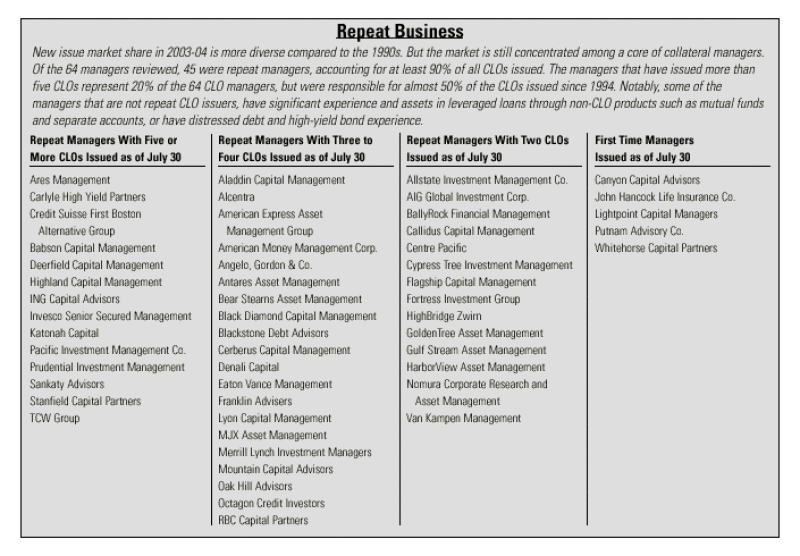
Demand for collateralized loan obligation paper has become so intense that some investors are not adequately differentiating between the many managers now accessing the market. "First time managers are pricing liabilities of AAA tranches at spreads that are comparable to repeat managers," said Milbert Bentham, associate director at Standard & Poor's.
Spreads on AAA tranches are as tight as LIBOR plus 32 basis points, while the number of managers has grown from 20 to 64 in the last five years. These trends are largely driven by strong investor demand and resilient CLO performance. But Milbert adds, "Investors in CLO deals should be more discerning between managers and the pricing shows that they are not."
Several factors are driving this demand, which has seen more than 40 deals issued so far this year compared to 26 deals throughout 2003.
J.P. Morgan has reportedly said it will nearly triple sales of CLOs through investors in Japan for 2004. Negative basis traders meanwhile--where an investor purchases a AAA-rated CLO note and simultaneously purchases credit protection from monoline insurers through a credit default swap--are active, as are insurance companies looking for yield. Traditional buyers such as conduits and structured investment vehicles are snapping up paper after time out of the market and there is an increasing number of high-grade CDOs of ABS.
S&P's findings do not take into account the pricing for the lower-rated tranches, nor the equity component. Vandana Sharma, a director at S&P, explained that the rating agency only reviewed the top-rated tranche because structural differences would make the comparisons harder with lower-rated tranches. "However, the pricing of AAAs is still important. When high-yield CBO deals ran into trouble in 2001-02, the AAAs traded at a significant discount. Then to issue a new deal, spreads reached up to LIBOR plus 65 basis points and above," Sharma said.
This is clearly not a problem to many CLO investors right now, who are often pitched on the strong performance of senior secured loans relative to CBOs. But if the market turns, manager ability and style may save investors from a sharp shock. "Only six CLOs rated by S&P have been downgraded, and these had significant bond buckets, but CLOs are not immune from deterioration," said Sharma. "All CDOs are leveraged products." Furthermore, "If you monitor the loan trends, realized recoveries are down and weighted average spread cushion has declined," she added.
Sharma suggests investors really look into a manager's style and experience. "Managers have different strategies. Some won't buy second-lien loans or CCC assets. Some look for longer ramp-up periods. There are managers that don't trade actively and prefer not to sacrifice credit quality for yield. It's not just a matter of initial credit selection, but actively monitoring the portfolio and the manager's consistency with its stated investment philosophy," she said.
Both Sharma and Bentham point out in the survey that there are in fact very few new managers. For instance, the portfolio managers of one recent entrant, Whitehorse Capital Partners, came out of Highland Capital Management. Avenue Capital Management may be issuing its first CLO in the coming weeks, but the team is led by ex-Franklin Advisers portfolio manager Richard D'Addario.