Top Section/Ad
Top Section/Ad
Most recent


JP Morgan overtakes HSBC to go top for the region

Highly anticipated report did not mention future role of AT1 capital

Surprising alignment on stablecoins and strong support for tokenised assets, but details are sparse

US broker has opened office in Milan, Stockholm will be next
More articles/Ad
More articles/Ad
More articles
-
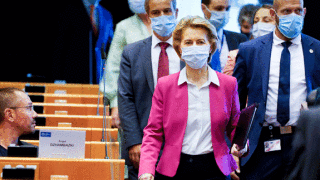
 The European Commission delivered its proposal for Next Generation EU on Wednesday, marking a sea change in the bloc’s relationship with the capital markets as it proposes truly shared borrowing to finance expenditure for the first time. The move could make the Commission the biggest supranational and agency borrower by some distance, Lewis McLellan reports.
 -
The Covid-19 pandemic has caused a “quantum” change in the amount of capital required to finance development, according to the head of the European Bank for Reconstruction and Development (EBRD).
-
Hong Kong’s capital markets were left roiling this week as investors tried to grasp the significance of a new national security law. Some fund managers are jumping on opportunities amid the ensuing confusion, but other market watchers see the city losing its financial edge. Jonathan Breen reports.
-
China’s auto ABS market has seen a slew of tightly priced deals this month, thanks to ample liquidity onshore and the growing strength of domestic investors. While very short-term trades have been popular, appetite is rising for longer revolving structures, said bankers.
-
The European Commission has published its proposal for an EU recovery fund. Next Generation EU, as it has been dubbed, has impressed onlookers with promises of €500bn of grants and a further €250bn of loans for countries affected by the coronavirus pandemic.
-
Cboe Global Markets will reopen its open-outcry options trading floor at the beginning of June, after more than two months in which the world’s major derivatives exchanges have operated exclusively electronically.