Germany
-
Deutsche Hypo has mandated joint leads for a €500m five year mortgage Pfandbrief to be launched in the near future.
-
Landesbank Hessen-Thueringen (Helaba) sealed its place as the largest covered bond issuer so far this year after doubling the size of a seven year public sector backed Pfandbrief on Thursday. The approach, which mirrors last year’s strategy, has enabled the bank to raise a lot of funding at competitive levels while giving investors much needed liquidity, as well as minimising its asset-liability mismatches.
-
German bankers, who have been busy nursing their sore heads after celebrating their country’s World Cup victory on Sunday night, will not have been overly burdened by DG Hypothekenbank’s drive-by Pfandbrief syndication on Monday. Being the rarest issuer from one of the most technically squeezed jurisdictions in Europe, a strong outcome was never in doubt. Painkillers may however be required for the allocation process.
-
Three issuers launched covered bonds this week with varying results, which suggested that the converging trend between core and peripheral Europe has stalled. Banca Monte dei Paschi di Siena (MPS) struggled to attract anything like the demand seen in its previous covered bond as Portuguese woes outweighed the programme’s rating upgrade into investment grade territory.
-
DG Hypothekenbank has mandated leads for a seven year mortgage covered bond to be launched early next week.
-
HSH Nordbank opened books on Thursday for a deal which took advantage of Europe’s core markets’ recent tightening versus its periphery. Leads produced an oversubscribed book as Bunds rallied and peripheral sovereigns continued to struggle.
-
HSH Nordbank has mandated joint leads for a €500m five year mortgage Pfandbrief, which is expected to be priced on Thursday. Market conditions for core issuers look favourable with Bund yields tightening further.
-
Bayerische Landesbank took advantage of an empty market to price what could be one of the last covered bonds before the summer lull kicks in. The €500m seven year Pfandbrief attracted a substantially oversubscribed and granular book that gained solid momentum from the start — in contrast to other recently issued Pfandbrief.
-
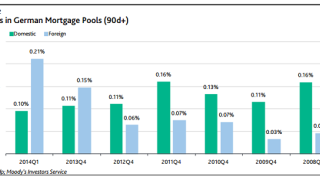
 Arrears in foreign assets backing German mortgage Pfandbrief increased by 40% in the first quarter of 2014, according to Moody’s, although the share of foreign mortgages in Pfandbrief cover pools is on a steady decline.
 -
Germany will not accept the latest iteration of the European Commission’s discussion on the liquidity coverage ratio (LCR) calling for a minimum A- rating for eligibility into the putative class 1B. Non EEA issuers of bonds rated AA- or higher may get into level 2A. LCR talks will be extended, but not the implementation date.
-
Berlin Hyp opened books on Monday for a deal which gave a positive litmus test on the condition of the core Pfandbrief market. The issuer may have been able to price a €500m deal at flat to Euribor but opted for a more liquid size at 1bp over mid-swaps in a move that was applauded but which shows resistance to sub-Euribor pricing has yet to be broken.
-
BPCE, Muenchener Hypothekenbank and Belfius Bank all launched 10 year covered bonds on Monday, underscoring the impression that investors are confident European yields could keep heading lower. Where once long end demand was dominated by real money, banks are now more dominant, a change that has been driven by the improved status of covered bonds in the liquidity coverage ratio.