Free content
-
 Ukraine’s political establishment was shaken up and, in large part, replaced by newcomers early in 2019. The lead up to the election was fraught, as investors’ fear of the unknown drove up Ukrainian rates. But President Zelensky swiftly won over the international community, setting up a superb run of borrowing.
 -
Turkey’s position economically, and from a capital markets standpoint, is better at the end of 2019 than it was a year ago. However, that is not to say all is well with the country — far from it. Prospects for 2020 are, at best, mixed with growing concerns over central bank independence and high debt levels
-
The loan market has had a great couple of years in the Middle East but in 2019 the bond market stole its thunder. However, as the region tries to wean itself off hydrocarbons, the sheer scale of financing needed means both markets will have plenty to do over the next 10 years. Mariam Meskin reports
-
US rate cuts were, admittedly, the driver behind the Latin American international bond market’s return to form in 2019. Although regional growth remains disappointing, there are encouraging technical and fundamental signs to be found
-
Emerging markets borrowers have been much slower to join the caravan of green and sustainability-linked financing that has swept up so many companies in western Europe. This is not because firms in CEEMEA are indifferent. As Mariam Meskin reports, interest is spreading, but companies must overcome practical obstacles, which will take time
-
New sources of capital and new financing models are appearing for emerging markets borrowers as investors broaden the search for yield. As Mariam Meskin reports, traditional EM bank lenders and bond buyers now find themselves battling direct lenders and private capital markets
-
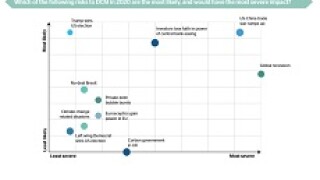
Markets go into 2020 fretting about a global recession and an escalation of tradetensions between the US and China, according to 25 heads of debt capital markets in the EMEA market, in Toby Fildes’ annual outlook survey. Respondents are mildly pessimistic on spreads and fees in the primary markets as well. But on the plus side, bankers are feeling hopeful about sustainability-themed bonds and almost unanimously believe issuance will top $270bn.
-
For corporate treasurers, the rates markets’ transition away from Libor and other Ibor benchmarks has created a messy future for their derivatives portfolios that many would prefer not to think about. Uncertain liquidity in new products and having to understand volatility in the new benchmarks are complicating the migration but there are signs of progress amid the confusion, writes Ross Lancaster.
-
A fuse has been lit on renewables hedging. In offshore wind alone, a wall of investment is set to hit the industry over the next two decades, one that will take many project sponsors into cross-border investments. Those prospects are already deepening hedging markets, writes Ross Lancaster
-
After leaving the EU, the UK will face continuous and infinite choices over how aligned to remain for financial services. Meanwhile, London looks set to continue to leak activity to EU hubs, several of which are developing their own specialisms
-
Equities are at record highs, rates at record lows; the US is quarrelling, China is slowing. As 2020 begins, participants are divided on which way markets will move. Toby Fildes picks 10 themes
-
As it spawns innovations everywhere from new issues to collateral management, is blockchain the technological key to digitising capital markets? And if it is, will that be through public versions such as Ethereum or private confidential networks? Or is this focus on distributed ledgers missing the point and the real need just to automate antiquated manual and bilateral processes? Julian Lewis reports