Derivs - People and Markets
-
A short-lived idea that guaranteed structured notes could make it within the scope of the Federal Deposit Insurance Corp. new government debt guarantee program was snuffed out Thursday.
-
Japan’s decision to dust off an old public funding law for banks will have a positive impact on capital adequacy, notably for those with smaller capital bases hit by losses on overseas collateralized debt obligation investments, according to market participants.
-
London-based alternative investment manager Amiri Capital plans to launch a Sharia-compliant global equity long/short fund of funds within weeks that will hedge positions via unconventional derivatives.
-
The price by which eligible credit default swaps referencing Washington Mutual Inc. will be settled in cash landed at 57% earlier today, meaning protection sellers will pay out 43 cents on the dollar. That figure is lower than the expectations of some Street players.
-
Colin Stewart has shifted to Merrill Lynch’s exotic credit trading team in New York as a managing director making markets for index exotics.
-
After not getting help in the U.K. or Irish government bailouts, derivatives dealers and end users are also concerned that structured notes will be left out of a temporary U.S. program guaranteeing unsecured debt.
-
Exotic credit structuring staffers at Merrill Lynch in Hong Kong left the firm this week. The three-person hybrid structuring team, headed by Carl Im, was shuttered and Vivek Mohindra, director of structured credit trading, and James Siegal, a structured credit official focusing on hedge funds, also left.
-
Jefferies & Co. has hired Jason Roelke as head of derivative sales as part of the firm’s plan to expand its sales and trading platform with institutional clients in mind.
-
Royal Bank of Scotland has appointed Brian Reid as its global head of financial institution sales in London, reporting to John Hourican, chief executive of global banking and markets.
-
With deadlines for transferring over-the-counter trade confirmation sheets on flow trades from paper to electronic drawing in, there is concern international banks based in Asia are lagging behind.
-
The practice of hedging cash positions by buying credit default swaps on monolines that have wrapped security issues is becoming uneconomic as the cost of protection on those companies rises.
-
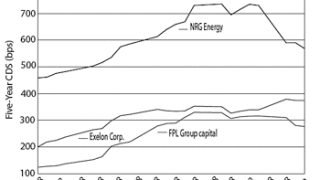
 Credit default swaps on utilities and independent power companies are gapping out on increasing concerns about refinancing challenges and counterparty credit risk.