Derivs - Credit
-
The prospect of government intervention in India's banking sector in the form of capital injections or funding guarantees should alleviate some pressure on names that have seen credit-default spreads widen to historic highs.
-
BNP Paribas has hired Arne Groes as its new global head of flow credit trading in London, replacing Eric Dumas, who has taken leave.
-
Five-year credit default swaps protecting against a default in Russia’s sovereign debt cracked through the 1,000 basis points mark yesterday, pushing them around the levels for insuring against Iceland defaulting when its banking sector collapsed.
-
 The volume of recovery rate swaps trading hands is taking off amid rising defaults in investment-grade names and a series of unexpected recovery values landed in the recent settlement auctions for credit default swaps.
 -
The price by which eligible credit default swaps referencing Washington Mutual Inc. will be settled in cash landed at 57% earlier today, meaning protection sellers will pay out 43 cents on the dollar. That figure is lower than the expectations of some Street players.
-
Colin Stewart has shifted to Merrill Lynch’s exotic credit trading team in New York as a managing director making markets for index exotics.
-
Moody’s Investors Service is close to providing guidance about how it will update correlation assumptions when rating corporate collateralized debt obligations and CDOs of asset-backed securities.
-
Royal Bank of Scotland has appointed Brian Reid as its global head of financial institution sales in London, reporting to John Hourican, chief executive of global banking and markets.
-
The traditionally tight spread between credit derivative indexes and credit default swaps that make up the index has broken down because of the demand for single name protection.
-
The practice of hedging cash positions by buying credit default swaps on monolines that have wrapped security issues is becoming uneconomic as the cost of protection on those companies rises.
-
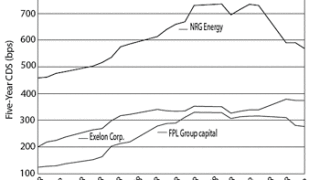
Credit default swaps on utilities and independent power companies are gapping out on increasing concerns about refinancing challenges and counterparty credit risk.
-
Raising the quality of data for modeling the performance of reference assets is key to the industry’s future, according to attendees at the 14th Annual Information Management Network ABS East conference.