

When Chinese premier Wen Jiabao delivered his keynote policy speech to the National People’s Congress in early March, the message was clear: China must move away from the low-cost, investment-led growth model that has supported its rapid rise over the past two decades.
Premier Wen announced a new annual GDP growth target of 7% for the next five years, down from the previous 8% goal, and that household consumption should play a bigger role in this growth. He pledged that the service sector should account for almost half of GDP over the next five years, while tens of billions of renminbi would be invested in building affordable housing, improving education and ensuring a more comprehensive health and social welfare system.
“Expanding domestic demand is a ... basic standpoint of China’s economic development as well as a fundamental means and an internal requirement for promoting balanced economic development,” Wen said. “China’s economy needs to be quickly put on the path of endogenous growth.”
Despite these eye-catching pronouncements, observers could be forgiven for feeling a sense of déjà vu. After all, Wen had delivered very similar messages in the very same hall on a number of previous occasions, while a similar commitment to rebalancing the economy formed a large part of the 11th five-year plan.
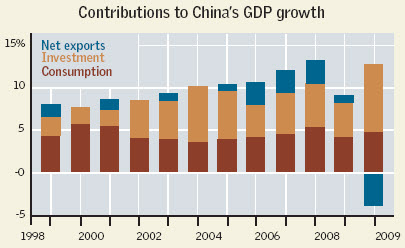
Yet little, if any, headline progress was made towards these goals. Household consumption as a share of GDP fell from 40% in 2005 to 35% in 2009; investment surged to a staggering 94.6% of GDP in 2009; and China’s foreign exchange reserves swelled above $3 trillion at the end of March.
According to Pieter Bottelier, professor of China studies at the Johns Hopkins School of Advanced International Studies, Beijing’s failure to make tangible progress towards its stated rebalancing goals in its last five-year plan was largely a result of the global financial crisis.
“The crisis caused GDP growth to plummet and scared the wits out of the Chinese Communist Party, who reacted with a massive spending programme which unsettled all rebalancing efforts. The priority became to prevent further economic downturn and restore employment,” says Bottelier, a former chief of the World Bank’s Beijing mission.
CONSUMPTION GROWTH STRENGTH
The headline numbers only tell part of the story, however. Although household consumption fell as a proportion of GDP during the previous five years, some experts are quick to point out that consumption actually grew significantly in real terms over this period.
The decline as a proportion of GDP, they say, was instead a reflection of a massive increase in government-led investment over this period, especially in the wake of the global financial crisis.
So while savings rates remain relatively high, it is a misnomer to suggest that Chinese consumers are reluctant to spend, argues Andy Rothman, chief China macro strategist at independent brokerage CLSA. “China is already the best consumption story on the planet by many metrics; retail sales, car sales, TV sales, the list is long,” he says. “Consumption is only small in the sense that it represents a small share of GDP growth, due to the fact that investment has grown so fast off such a large base.”
Given that consumption has already been showing double-digit growth over the past five years, most economists acknowledge that consumption is unlikely in the short term to grow significantly faster than its present rate.
With net exports expected to make a relatively small contribution to GDP growth – China posted a minor trade deficit in the first quarter of this year, and Rothman believes net exports could contribute nothing to GDP growth this year – investment is likely to remain the disproportionate driver of Chinese growth this year – and indeed over the next five years.
The RMB4 trillion stimulus package officially ended at the end of last year, and authorities have been battling to squeeze credit and liquidity growth while trying to regain control over the pace and direction of lending; meanwhile concerns are mounting over the fiscal health of many of China’s local governments.
The worry now is that investment growth could slow sharply before consumption picks up the slack – leading to substantially slower overall growth.
“The question is whether the current model will run into a brick wall all of a sudden, or whether it will be a gradual process of change,” says Rothman.
HARD LANDING?
One prominent proponent of the hard landing thesis is Nouriel Roubini, professor of economics at New York University’s Stern School of Business, who predicted in a recent research note that increasing fixed-asset investment will become impossible for China beyond 2013, and that, with consumption unlikely to increase faster than at present, China is “poised for a sharp slowdown” within the next five years.
Victor Shih, assistant professor of political science at Northwestern University, says that government efforts to stimulate greater consumption by removing some of the underlying causes of a relatively high savings rate – through affordable housing, improving healthcare and strengthening the social safety net – require further investment, and will therefore simply exacerbate local government debt concerns, while doing little to boost consumption.
“Rebalancing policies are self-defeating,” he says. “Central government could have made things a lot better had they financed social housing, for example, from the central budget, but instead they have once again kicked the burden down to local authorities, which can only get money from two sources: borrowing more, or taking money directly from households [in the form of higher taxes, or low interest rates]. Whichever way they do this, it directly contradicts efforts to boost consumption by taking money away from the very people they should be encouraging to spend more.”
Shih argues that rising levels of local government debt are likely to trigger a full-scale financial crisis in the coming years, forcing the government to intervene to write off local government non-performing loans and bail out the state-owned banks; this, he says, will lead to a hard landing for the economy.
Michael Pettis, professor of finance at Peking University, believes that China’s current investment-driven growth model has led to a transfer of wealth away from households to banks, local governments and state-owned enterprises in the form of an undervalued currency, lagging wage growth and artificially low interest rates. If investment growth were to slow, it would result in a significant economic slowdown; therefore, he says, the incentive to maintain the current growth model is strong.
“There is simply no way China can generate sharp increases in household consumption while keeping investment levels high unless investment in the aggregate can generate more than sufficient economic value in the next few years to justify the costs,” he wrote in a recent research note.
INFRASTRUCTURE INVESTMENT
CLSA’s Rothman acknowledges that infrastructure investment is unlikely to generate significant economic value in the near term. But there is no fundamental contradiction between investment growth and consumption growth, he says. “China’s infrastructure build-out is a long-term investment, and I believe that we will see the payoff,” he says.
The logic here is clear: while some investment has undoubtedly been misappropriated and wasted, the bulk of the current infrastructure investment boom is laying the framework for deeper, domestic-driven growth, greater urbanization and for more rapid inland development.
“Much of China’s current investment expenditure is geared towards domestic, consumer and development-oriented projects – sewage systems, metro systems – and is in line with China’s long-term development needs,” says Louis Kuijs, senior economist at the World Bank’s China office. “Starting in 2008 and definitely in 2009, we saw a shift in the composition of investment towards more domestic sectors.”
Both Rothman and Bottelier acknowledge that the unprecedented scale of credit growth in 2009 and 2010 has led to a heightened risk of non-performing loans, but think that the likelihood of the current credit-fuelled investment growth model snowballing into a financial crisis and a hard landing is low.
Bottelier argues that the spectre of local government non-performing loans has been overstated. Moreover, with overall debt to GDP levels below 6% and with foreign exchange reserves totalling $3 trillion at the end of March 2011 – not to mention the myriad state-owned assets and a vast sovereign wealth fund – Rothman believes the central government could cover the cost of bailing out banks and local governments without undermining economic growth.
“If things go wrong, the hit will come on the balance sheet of the Party, not the banks, and the Party is in my opinion the world’s most liquid financial institution, so it will pay the loans and move on,” he says.
“An American style financial crisis won’t happen,” says Bottelier. “The Chinese government has a hat full of rabbits. Of course this will drive up levels of state indebtedness relative to GDP, but ... unlike the US, China can still buy time.”
 |
Of course, buying time is not the same thing as undertaking genuine economic and structural reform. But the commitment to reform, says Bottelier, is both genuine and already in evidence. He cites the fact that service-sector employment is now growing faster than manufacturing; that wages, despite a brief pause in 2009, have continued to show double-digit growth over the past five years and that real wages grew faster than GDP in 2010; that consumer finance loans have increased from just 5% of household disposable income in 1999 to 43% at the end of 2009; and that China’s currency has appreciated by more than 4% against the US dollar since the ending of the de facto peg in June 2010.
He adds that the vast majority of China’s political leadership is committed to boosting domestic demand – a genuine change from when the previous five-year plan was announced in 2005. “At that time, they were talking the right talk, not walking the right walk. Nowadays, there is hardly a main politburo leader’s speech that doesn’t put rebalancing front and centre,” Bottelier says.
Many local officials, too, are increasingly focused on domestic rebalancing. At a recent conference organized by the local party secretary of a rural county outside Shanghai, party bosses spoke of the importance of moving towards a domestic-market focused economic growth model. “When county-level political bosses in China realize that the future of their economy relies on developing domestic demand, this will be the most powerful driver towards rebalancing, and it’s already starting to happen,” Bottelier says.
So long as investment remains strong, it will be difficult for household consumption to account for a significantly higher share of GDP, but there is no contradiction between the two, he says. “It may take time before household consumption climbs back to 40% of GDP, but the trend is in motion, and momentum will gather,” says Bottelier.
Rothman also sees clear evidence of progress towards rebalancing, both due to government policy and external economic factors. “The minimum wage in Shanghai has increased more than 100% in the past 10 years, we’ve seen export rebates reduced on hundreds of goods, environmental rebates enforced more strictly; you don’t do these things if you’re focused solely on growth or on exporting as much as possible,” he says.
He forecasts that investment growth will remain in the region of 25% year-on-year for another few years at least, by which time the bulk of the current round of infrastructure build-out will be complete, while progress will also have been made on healthcare, welfare and pension reform. Slowing investment growth from then on will necessitate slower headline GDP growth, but, with the foundations for more rapid consumer growth more firmly in place by this time, this is both planned and desirable.
“The Party has been signalling for the past few years that it no longer wants double-digit growth, it wants better-quality growth, and this is in line with its plans,” he said.
TOWARDS 7% GROWTH
Barring a major external shock, Bottelier also believes that growth will slow, but that it “won’t conceivably” drop below 7%. “There is a high probability of slower growth in the years ahead, and perhaps indefinitely,” he says. “But the composition of growth should be a healthier one. Seven percent growth won’t be the end of the China story.”
Kuijs of the World Bank believes that it “shouldn’t be a big problem” for China to achieve rebalancing with moderately lower overall growth, but stable or even stronger employment growth, something he believes is more important for its political leaders than headline growth.
“If China is able to pursue labour-intensive, service-sector oriented urban growth through rebalancing, this is exactly the way you can create more jobs per percentage point of GDP growth, so even though overall growth will be a little lower, urban job growth could be even higher,” he says.
Although he believes that a rebalancing of China’s GDP composition is unlikely to occur rapidly and that policy risks remain, the likelihood of a hard landing in the near term is remote. “China’s macro fundamentals are pretty strong, and it has a good track record of doing what is necessary at the time that is necessary, and this continues to be the case,” he says. “So I remain fairly optimistic about China’s macro situation.”
Shih, however, believes that while China may be able to maintain 8%-plus GDP growth for the next two or three years by continuing to rely on bank lending to fund growth, at some point deb levels will become unsustainable, precipitating a hard landing. “I don’t think the current model is sustainable over a 10-year horizon,” he says. “At some point China will either have to accept 4–5% range growth, or something else may happen.”
And even if the Chinese authorities do manage to bring long-term growth rates down to around 7%, with consumption playing a greater role in driving growth, this would have an impact on global trade and growth patterns.
One thing is clear: with China’s political leadership now apparently committed to structural reform of the economy, China’s growth model is set to undergo even closer scrutiny in the coming years. To that end, the debate has only just begun. And the outcome will have profound effects for the future of both the domestic and the global economy.