Top Section/Ad
Top Section/Ad
Most recent


Highly anticipated report did not mention future role of AT1 capital
Surprising alignment on stablecoins and strong support for tokenised assets, but details are sparse

Using AI to facilitate credit decisions poses regulatory problems

Investors should feel more confident when BNPL products are regulated like mainstream consumer credit
More articles/Ad
More articles/Ad
More articles
-
ANZ has become the first Australia-based member of LCH.Clearnet’s SwapClear interest rate swap central clearinghouse and has cleared its first trade.
-
 Only a few financial firms that have signed up to the Hong Kong Trade Repository are submitting trade data, with the rest of the counterparties waiting until December when mandatory interim reporting is enforced.
 -
Pricing bilaterally traded over-the-counter derivative contracts that are entered into following the enforcement of the frontloading obligation under the European Market Infrastructure Regulation could result in market dislocation, according to the International Swaps and Derivatives Association and the British Bankers’ Association.
-
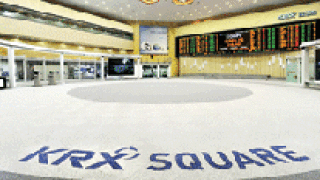
The Korea Exchange is conducting research to determine which non-deliverable forward currency pairs, in addition to Korean won and U.S. dollar, the bourse’s central clearing counterparty will clear when the service starts in 2014.
-
Should derivatives regulation differ between provinces in Canada, then it could result in market participants having to comply with rules in more than one province and disincentivize dealers from transacting with counterparties based in Canada, according to market participants. Regulators in Canada, however, are aiming for the provincial rules to be identical.
-
The European Securities and Markets Authority has secured a delay to the deadline for the registration of the first trade repositories until Nov. 7 from Sept. 24. This means that counterparties will not be expected to report to trade repositories until Feb. 2014.