Free content
-
 When the shadowy figure known as Satoshi Nakamoto launched bitcoin in 2009, few predicted that the technology underpinning it would, in a few short years, be hailed as an invention as important as the internet. Capital markets are on the front line for disruption, writes Lewis McLellan.
 -
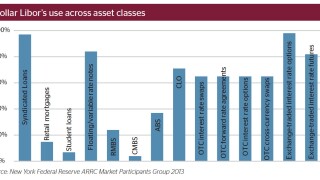
It is six months since Andrew Bailey, head of the UK financial regulator, set the clock ticking on a transition from the London interbank offered rate to an alternative. But if credible replacements are to be ready by his 2021 deadline, there is still a mountain of work to do. Ross Lancaster explores the risks of phasing out the old benchmark and asks if it could yet survive.
-
After a superlative funding year for eurozone public sector borrowers, thanks partly to the European Central Bank’s asset purchase programme, some of the region’s top issuers and investors discussed with GlobalCapital the outlook for 2018 — when the ECB will start halving its monthly purchases to €30bn.
-
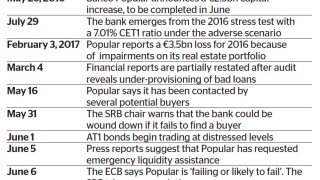
Banco Popular’s failure is likely to go down as a successful first case for the Single Resolution Board, but the process has raised big questions about transparency, liquidity support and capital. Learning from these issues is going to be crucial for the future of European bank supervision. Tyler Davies reports.
-
Banks and other financial firms operate in complex lattices of regulation. But for any firm based in the UK and operating internationally, Brexit means they have no idea what regulations will apply, come March 2019. They cannot afford to do nothing, yet do not know what to plan for. As Nigel Owen reports, the response has been to plan for every scenario, including relocation from London.
-
MiFID II rips up the market rulebook — and replaces it with a whole bookshelf of new rulebooks. Entire divisions have worked flat out to get ready for the regulation’s official start on January 3, and it’s certain to overturn the established competitive order. Nell Mackenzie looks at the winners and losers.
-
The era of quantitative easing is ending. The benefits for the real economy will be hotly debated. But for the capital markets the key question will be how investors react to the withdrawal of official money printing and the inevitable rise in volatility, writes Ralph Sinclair.
-
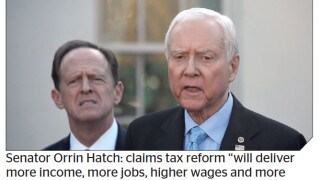
Economic conditions are ripe for the mergers and acquisitions that drive capital markets. Into this mix comes a potential US tax reform more radical than any for decades. This is bound to tilt boardroom decisions about strategy — if nothing else, US CEOs could suddenly have more cash back at HQ than they know what to do with. Jon Hay and Sam Kerr report.
-
2017 saw some serious capital raising by European banks. Four European globally systemic banks, in four monster rights issues, raised more than €30bn — partly to deal with non-performing loans and partly to reclaim their places in global investment banking and capital markets. Even banks that did not turn to the equity markets sought to conserve capital — but is 2018 the year when belts will start to be loosened again? Owen Sanderson reports.
-
MiFID II might qualify as one of the wonders of the modern world. At 1.5m paragraphs, including all its appendages, it swathes a blanket of mind-numbing verbiage around activities that were once fast and exciting.In that sense, it is the embodiment of modern financial markets and of modernity itself. By Jon Hay.
-
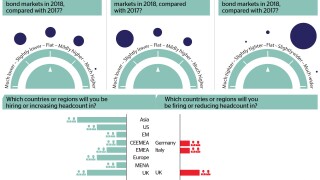
Heads of debt capital markets at 20 of the top investment banks shared their thoughts on how they see 2018 with GlobalCapital in December. Almost all banks are optimistic about business prospects, especially for financial institutions and SRI issuance — though they expect spreads to widen. European politics has slipped down their list of worries, but asset bubbles have risen to the top. Research by Toby Fildes and Ralph Sinclair, graphics by Sam Medway and Jon Hay
-
The big beneficiary of the US’s international fatigue will be China. And China is more than ready to take advantage. By Toby Fildes.