Free content
-
 Deal-contingent products — flexible derivatives for hedging the FX risk of cross-border acquisitions — are moving from the private equity industry to other markets. Infrastructure is considered a prime fit for the tool. But tricky accounting standards and incoming regulation could complicate the instruments’ roll-out to new users, writes Ross Lancaster.
 -
The perennial dream of the investment grade loan market is a large company looking for finance to back its jumbo acquisition. With lenders flush with cash, borrowers confident and growth returning to Europe, this year might turn that wish into reality, writes Silas Brown.
-
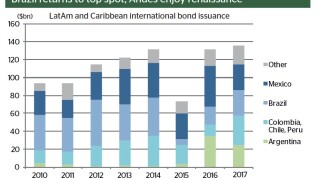
Latin America faces elections in three of its largest economies this year, but bond market participants are feeling confident, after technicals helped 2017 to defy all expectations and with economic activity set to improve in 2018. Oliver West reports.
-
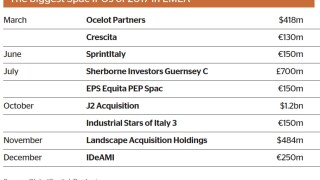
One of the fastest growing corners of the equity capital markets, particularly in the UK, has been the listing of investment funds and cash shells. The popularity of this asset class will continue in 2018, just as long as rates stay low and inflation continues to rise. Aidan Gregory reports.
-
With yields compressed and equity volatility at a historically low level, hunting for consistent returns has been a challenge for asset managers and institutional investors alike. But as Costas Mourselas reports, the meteoric rise of risk premia strategy, a type of passive investing, promises to at least partially alleviate those woes.
-
As 2018 begins in Middle Eastern debt markets, there is much to do, and much to contend with. Investors in the region are used to unrest and tension but it has started to crop up in unexpected places. Francesca Young and Bianca Boorer report.
-
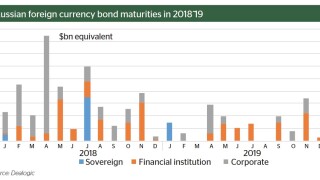
The fall-out from the failure of private lender Otkritie continues to weigh on Russia’s financial sector, but heavy bond redemptions and higher oil prices are expected to support corporate issuance in 2018. Virginia Furness and Bianca Boorer examine the outlook for Russia’s capital markets.
-
Emerging market bonds had a fantastic 2017, with issuance volumes the highest on record and returns the highest in global fixed income. But with rates ticking up and EM valuations looking stretched, 2018 will be a much trickier year for investors to navigate. Virginia Furness reports.
-
While US Fed rate rises and the ECB’s tapering of its QE programme could knock some of the froth off the top of exuberant EM debt markets next year, there will still be plenty of opportunities for debut and frontier issuers to raise cash in innovative ways. Virginia Furness reports.
-
Corporate bond issues in Europe with eight or nine bookrunners have become commonplace. The trend is symptomatic of title inflation — originally there was one bookrunner among two or three lead managers — and of the care with which companies share out their ‘wallet’ of ancillary business to relationship banks. For the banks it means having to do a lot more deals to earn the same money — and having to contend with an unwieldy syndicate. As Nigel Owen reports, at least the market is competitive, but when conditions get trickier, issuers may want more streamlined teams.
-
Private debt is in vogue. US private placements and Schuldscheine — with a little help from Euro PPs — racked up roughly $100bn-equivalent of new issuance for companies in 2017. They should beat that in 2018. But with demand outweighing supply, investors have to stretch to accommodate borrowers, writes Silas Brown.
-
The high yield market is struggling to attract new issuers. Some believe the more flexible documentation on loans and alternative lending are luring debut leveraged debt issuers away. Could high yield lower its requirements to attract them back in 2018? Unlikely. But it can still find first time borrowers among companies unafraid of disclosure. Victor Jimenez reports.