Europe
-
The covered bond market is in danger of losing a swathe of real money investors who have been put off by low returns and declining issuance. But a rich new stream of demand from bank investors looking to fill their liquidity buffers could fill the vacuum in time. However, these buyers should be more interested in looking at the nascent floating rate format and not the fixed rate market that until now has prevailed.
-
Standard and Poor’s positive rating action on Depfa plc on Monday, and an expected rating upgrade from Moody’s that has yet to materialise, have had barely any impact on the issuer’s Irish covered bond spreads. The outlook should become clearer when further details of its ownership structure have emerged, bankers told The Cover on Tuesday.
-
After a long string of syndication success stories this year, the covered bond market finally saw some investor pushback on Tuesday when Landesbank Hessen-Thueringen (Helaba) issued a tightly priced two tranche Pfandbrief. The outcome gives ammunition to those that are concerned valuations have become overstretched. However the funding was very cheap, attracted exceptionally strong international demand and was placed with high quality accounts.
-
Declining Spanish covered bond issuance has resulted in higher levels of overcollateralization, said Moody’s on Tuesday. This is credit positive because bondholders are better protected.
-
Landesbank Hessen-Thueringen (Helaba) mandated leads for a dual tranche triple-A rated public sector Pfandbrief on Monday, for launch on Tuesday.
-
Spanish bank Kutxabank took advantage of improving conditions after a dismal open on Monday to issue the country’s fourth covered bond of the year. Following Swedbank and Bank of Austria last week with a seven year tenor, the deal is the first such tenor from Spain this year and a clear indication of where the sweet spot on the curve lies.
-
With a sizeable portfolio of variable rate mortgages, it makes sense for Stadshypotek to issue floating rate covered bonds, as this minimises interest rate risk and swap costs. Though the investor base for floating format covered bonds is still in its infancy, treatment of the asset class in bank liquidity buffers could soon be improved, and since FRNs are better suited for bank liquidity books, this is a market that could potentially deliver a substantial stream of demand.
-
Five Portuguese covered bond deals were upgraded on Friday by Moody’s, in a move that had been widely anticipated following the sovereign upgrade. But the upgrades came against an increasingly volatile credit backdrop which saw some peripheral covered bonds soften as their respective sovereign markets came under pressure.
-
 The decision by a joint venture between Russia and China to invest up to $2bn in key infrastructure projects will relieve the pressure on the Russian government to attract funds to offset the massive flight of capital
 -
The constructive covered bond constellation of conditions continued on Thursday as UniCredit Bank Austria took advantage of superlative funding conditions demonstrated in Swedbank’s deal on Wednesday to issue its third deal of the year. Despite pricing almost flat to the curve, the deal attracted one of the highest levels of oversubscription of any Austrian covered bond in two years.
-
Swedbank looks set to price the tightest non-German euro seven year benchmark covered bond in over five years, and with a negligible new issue premium. The transaction’s success drew on a confluence of positive factors.
-
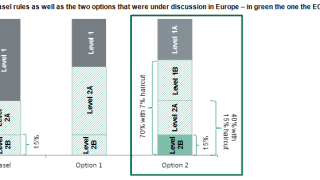
Covered bonds rated AA- or higher will be elevated to a Level 1 asset in Liquidity Coverage Ratio (LCR) according to an internal document being circulated at the European Commission. This backs up a press release from the Danish government last Friday. The improved structural bid is most likely to affect bonds lower rated bonds previously ineligible for the LCR, said analysts.