Euro
-
Veneto Banca and Rabobank have mandated leads for RMBS. The deals offer a generous pick up to what investors could expect in covered bonds given their comparably low risk.
-
 The improving quality of the mortgages which back Australian covered bonds means they require less collateral than in the past to sustain a top rating, said Moody’s in a report on Wednesday. The assessment comes a few days after Fitch’s quarterly overview, which showed a sustained increase in investment mortgage lending. — But this higher risk lending is correlated to Australian house price growth which, since the year 2000, has exceeded both Spanish and Irish house price growth, according to data from The Economist.
 -
Royal Bank of Canada could be ready to return to the euro covered bond market for the first time this year after emerging from blackout last week. It is one of only two Canadian borrowers that has not issued a euro benchmark this year, while Danske Bank’s research team believes Canadian issuance is set to pick up.
-
Bank of Scotland and Lloyds Bank announced a tender for three short-dated covered bond deals denominated in euros and sterling on Tuesday. This will be the borrower’s second liability management exercise in covered bonds undertaken within the past year.
-
Bankers reported better buying at the long end in peripheral covered bonds on Friday, while core markets were technically well supported. Despite improved signs of stability, the Street is long of inventory in the periphery and less able to absorb selling flows if they re-emerge, particularly at the long end.
-
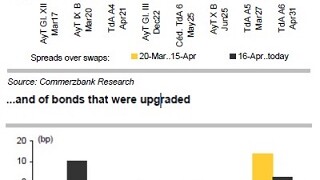
Spread widening in periphery covered bonds are a correction rather than a trend reversal, said Commerzbank’s research team this week.
-
Sovereign bond market volatility continued to buffet markets on Thursday and, after the slew of FIG issuance in the last week, there was a degree of supply indigestion. But covered bond bankers did not think there was much to be read into the lacklustre execution of this week’s German and Australian deals. The two issues were solid trades, but for idiosyncratic reasons lacked the sparkle of earlier deals.
-
The prospective amendment to the German Pfandbrief Act to give the German regulator authority over minimum overcollateralization (OC) may prove a credit positive, said Fitch on Tuesday. But the proposals are too thin on detail for any concrete rating action on programmes to be taken.
-
The covered bond market is in danger of losing a swathe of real money investors who have been put off by low returns and declining issuance. But a rich new stream of demand from bank investors looking to fill their liquidity buffers could fill the vacuum in time. However, these buyers should be more interested in looking at the nascent floating rate format and not the fixed rate market that until now has prevailed.
-
National Australia Bank opened books on Wednesday for its first euro benchmark of the year, deciding to follow the well-worn route of others with a seven year tenor, the eighteenth such maturity this year and the fifth this month. Though NAB took advantage of being alone in the market, underlying credit sentiment remains jittery.
-
Standard and Poor’s positive rating action on Depfa plc on Monday, and an expected rating upgrade from Moody’s that has yet to materialise, have had barely any impact on the issuer’s Irish covered bond spreads. The outlook should become clearer when further details of its ownership structure have emerged, bankers told The Cover on Tuesday.
-
After a long string of syndication success stories this year, the covered bond market finally saw some investor pushback on Tuesday when Landesbank Hessen-Thueringen (Helaba) issued a tightly priced two tranche Pfandbrief. The outcome gives ammunition to those that are concerned valuations have become overstretched. However the funding was very cheap, attracted exceptionally strong international demand and was placed with high quality accounts.