
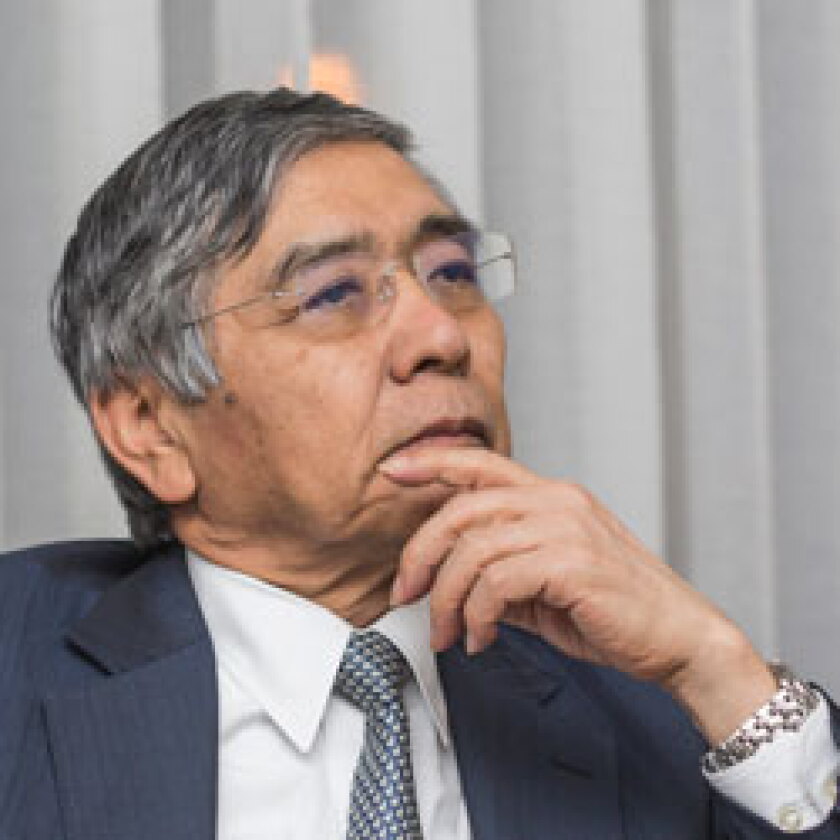
Bank of Japan governor Haruhiko Kuroda issued a strong defence of the central bank’s monetary policy on Tuesday, despite growing doubts among Japan-watchers that its unprecedented negative interest rates and vast quantitative easing can succeed in kickstarting the economy.
Kuroda insisted the full benefits of negative rates would show through “within a few months”.
The policy had already had positive impacts on the Japanese economy, he argued.
In an exclusive interview with Emerging Markets in Frankfurt, he emphasised that the reason why Japan’s economy had not yet shown the kind of improvement seen in the US — and to a lesser extent, the eurozone economy — despite massive monetary easing was because of the legacy of “15 years of deflation” before the current policies were launched.
“Our monetary policy is not targeted at the exchange rate,” Kuroda insisted in the wake of the decision by the US Federal Reserve to place the yen — along with the currencies of China, Korea, Taiwan and the eurozone — on a monitoring list to check for unfair exchange rate practice.
He said the Bank of Japan’s (BoJ) policy was to achieve a price stability target of 2%. “Our so-called QQE [quantitative and qualitative easing] introduced in April 2013 has had the intended impact,” he said.
“We expanded QQE in October 2014 and again, the impact on the economy has been as intended. The entire yield curve has declined significantly, making financial institutions’ lending rate to households as well as to the corporate sector decline significantly. This has had a positive effect on the real economy.”
INFLATION UP, YIELD CURVE DOWN
He acknowledged that Japan’s CPI inflation rate reached around 1.5% in 2014 but noted that, after that, two factors had made inflation decelerate. “One was somewhat weaker than expected consumption [in Japan] after the consumption tax hike in April 2014,” he said.
“More significantly, a sharp decline in oil prices started around July 2014. This significantly reduced the headline inflation rate and still the inflation rate is around zero. But if you exclude fresh food and energy items then the inflation rate has been 1.1% in recent months.
“We still think that the underlying inflation trend has improved significantly and, based on our assumption that oil prices will gradually recover [Japan’s] inflation rate should approach 2% in fiscal 2017.”
Kuroda defended the BoJ’s controversial decision to announce negative interest rates in January but to implement them the following month. “We introduced QQE with a negative interest rate to pre-empt financial market volatility and instability from affecting the economy and inflation dynamics,” he said.
“Already the entire yield curve has significantly declined and the lending rate on housing loans as well as on corporate loans has significantly declined. This will certainly stimulate corporate fixed investment as well as housing investment in coming months.”
The BoJ is still in the early days of introducing negative rates, Kuroda observed. “So maybe we have to wait a few more months before [we see] negative interest rates having a positive impact on the economy.”
SMALL BANK IMPACT
He compared the BoJ’s policy with the European Central Bank’s, which introduced a negative interest rate twice, reaching minus 0.4% applied to the entire reserve deposit held. That would certainly affect significantly the profitability of the [eurozone] banking sector, he said.
“In the Japanese case we introduced a three tier system and the portion on which minus 0.1% is applied is quite limited. Basically it is ¥10tr-¥30tr compared with ¥210tr of deposits, which still receive a positive 0.1% interest from the Bank of Japan.
“Yes, we introduced QQE with a negative interest rate quite recently but our system is likely to affect the banking system’s profitability in a quite small way. In the short run [that] will have a negative impact of the profitability of the banks.”
But, Kuroda said sceptics had to take into account three concepts. “First, in the last three years under QQE the Japanese banking sector enjoyed a historic high level of profits. Why? Because under QQE the economy recovered and credit costs also declined because bankruptcy declined,” he said.
“Secondly, the Japanese banking sector was not much affected by the global financial crisis. So, Japanese banks have an ample capital basis. So, while in the short run monetary easing will continue to affect banking sector profitability, in the medium to long run, once the economy recovers and the inflation rate reaches 2%, banking sector profitability will be substantially improved.”
Lastly, Kuroda said he was encouraged by Europe’s experience to continue with negative rates, “because QQE as well as QQE with negative interest rates has had its intended impact, not only the financial market but also on the real economy. The yield curve has declined but it will take a few more months before this significant decline in interest rates will have a positive impact on the real economy.”
DEFLATION LEGACY
Some critics have also argued that as monetary easing appears to have had less impact in Japan than in the US or Europe, this signals the failure in effect of the BoJ's aggressive easing since Kuroda took the helm of the Japanese central bank some three years ago.
Kuroda rejected this, saying: “The Japanese economy has been recovering from recession caused by the global financial crisis and also the Japanese economy is recovering from a long deflationary phase. The underlying inflationary trend is positive in the past 13 months reaching 1.1%.”
And, he added: “The Japanese economy, unlike the European or US economies, has had to recover not just from recession after the global crisis but also from a long, long period of deflation that really started in 1998 and continued for about 15 years until 2013.
"This long deflation made our monetary policy extremely challenging. Although the economic growth rate is basically low, the corporate sector has enjoyed a strong level of profit, the labour market is quite tight — probably the tightest in the last two decades or so — and wages are rising.
“And yet, we are still only half way because the inflation trend is still only 1.1%. Certainly wages have to rise much faster and the economy must grow much faster. But I think we have to understand that a clear improvement has been made.”