
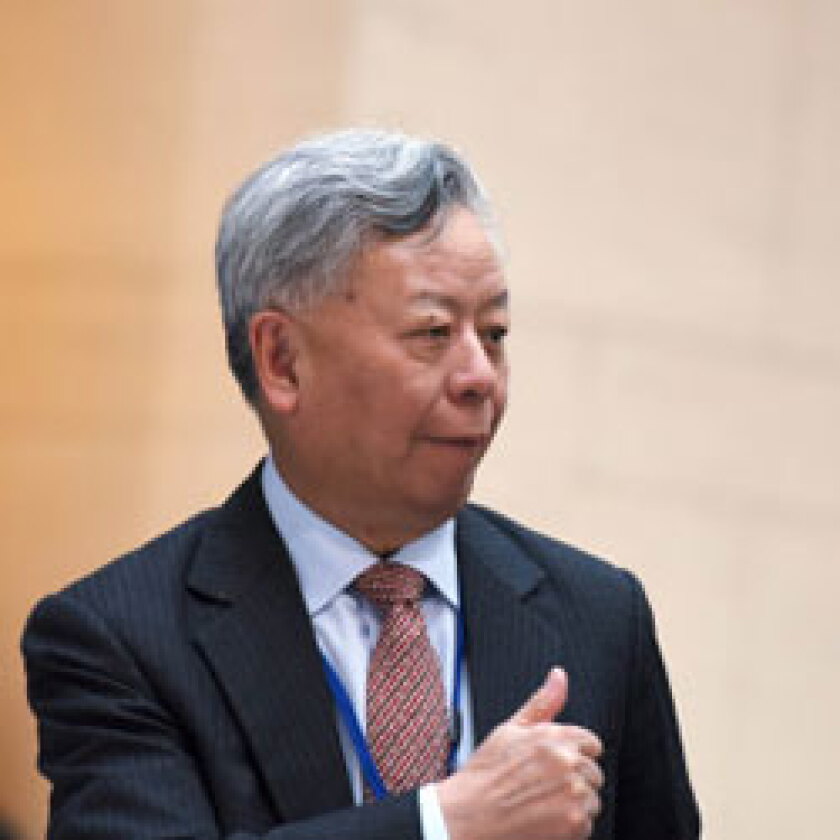
International investors are "very enthusiastic" about the prospect of investing in bonds and other debt instruments to be issued by the Asian Infrastructure Investment Bank, its president told Emerging Markets in an exclusive interview.
The comments by Jin Liqun were aimed at countering doubts about the ability of the new China-led institution to tap international capital markets, in view of its short track record and assumed inability to obtain triple-A status from international rating agencies.
It is not yet clear when the AIIB will need to start raising debt, but its board will consider its first lending projects this summer. Investment banks are sure to be keen to get involved in helping the new multilateral development bank raise funding.
Jin also revealed more than has previously been disclosed about the global nature and location of AIIB operations, and its relations with the One Belt One Road (OBOR) concept.
"I have done some preliminary study and survey of the demand for possible bond issuance for private placement of AIIB [instruments] and the response was very positive and good," he said.
"We believe the AIIB can benefit from the huge liquidity in the Chinese market as well as in the international capital market. Whether it will be through private placement or public offering [of debt instruments], this is something we will have to discuss. We have no fixed ideas but the response from the market is that either way it's fine.
"Early on I talked to Chinese investors and they were very positive and also I inquired about the demand in the international capital markets and it's OK. I'm pretty sure that the enthusiasm will be very high."
The Beijing-based AIIB is "still having internal discussions" on the optimum method of financing, Jin told Emerging Markets. "As a normal practice MDBs [multilateral development banks] would not spend all their capital on financing.
"They manage their equity capital to achieve returns and also do debt financing so that they can support projects in the borrowing countries. This is normal practice and we will more or less follow this practice.
"But this is a challenge at this stage because interest rates have remained very low for so long. A number of MDBs are faced with a tough situation of how to improve returns on their capital.
“This a new situation which may drag on for some time. We need to have a good discussion on this issue and we are seeking the support of the board as to the way in which we manage our finances.”
He said that he wanted reduce the funding cost to the minimum possible, thereby reducing the burden on borrowing countries. “Our bank's core principle is to be lean, clean and green,” he said.
“We want to be cost-effective. I take care of the bank's finances because we know that equity capital comes from taxpayers' money and we should be the best guardians of taxpayers’ resources."
GLOBAL COVERAGE
On the AIIB's proposed theatre of operation and project selection, Jin said: "Our bank is committed to serving all the emerging market economies of the members. It is not just the emerging market countries in Asia that will benefit.
“Certainly the majority of the borrowing countries will be Asian countries. But since we have emerging market economies from other regions like Africa, Latin American and Eastern European countries [in the membership] we may cover a more broadly geographical coverage.
“Over time, we need to strike a proper balance between the regional and non-regional borrowing countries and among the sectors because infrastructure projects can only play their role when the investment in infrastructure is well coordinated."
Jin clarified the relationship between the AIIB and the OBOR concept announced by China's president Xi Jinping to connect Asia and Europe via Central Asia — and also to link in part of the Middle East and Africa.
"One Belt One Road certainly is related to the AIIB but they are not the same thing," he said. "The AIIB is not created exclusively to finance OBOR projects. The AIIB covers more broadly countries across the world.
"Generally speaking, we highlight the importance of regional connectivity. Those projects which are good for the borrowing country with positive spillovers across borders will certainly receive high priority. The projects we can consider should be financially sustainable, environmentally friendly and socially acceptable."
The AIIB is "working with the World Bank, the Asian Development Bank, the European Bank for Reconstruction and Development, the European Investment Bank — and possibly with other regional development banks in the future," he said.
FIRST BATCH
The AIIB officially opened its doors for business early this year but intends to take a "step by step" approach to becoming fully operational, Jin told Emerging Markets.
The bank held its first board meeting on January 17 and the second on April 25-26. "Those two board meetings helped us set the stage for our operations. We approved all the basic documents and the basic policy papers and we discussed the way of moving forward.
"At the third board meeting in late June the management will deliver the first batch of projects for the Board to consider. Less than six months into operation, we can manage to launch projects because we had prepared them before the bank was operating, saving us time.
"We want the AIIB to be lean," Jin emphasised. "Learning from the experience of existing MDBs, we tried to expand out staff step by step, along with the expansion of programmes.
“I am not going to recruit a huge number of people sitting there waiting for jobs to do. When we focus on certain key sector such as power, road, railways, we can identify professionals and recruit these people."
Jin highlighted the fact that "over the first couple of years there might be high concentration [of AIIB projects] in one or two countries and in one or two sectors because we want to build up the portfolio as quickly as possible.
“We cannot wait for some countries to come up with the projects while those countries with projects have to wait. Over time, we will achieve country balance and sector balance."