
Apple CEO Tim Cook has plenty to be drooling over right now. Shares in the US tech company rose 8% last night after it announced record revenue and profit growth during the final three months of 2011 (its fiscal 1Q 12).
But on the conference call, there was one market in particular that Steve Jobs’ successor wanted to eulogise about: China.
While Apple has built much of its success on products manufactured in China, it is rapidly becoming one of its key retail markets as well.
China’s burgeoning middle-class, it appears, is infatuated with all things Apple – for evidence, one only need look at thechaotic scenes that forced Apple to abandon its iPhone 4S launch at its flagship store in Beijing earlier this month, as thousands of people who had camped out in sub-zero temperatures overnight to get their hands on the new smartphone tussled with security guards and pelted the store with eggs when it failed to open on time.
Cook told analysts that he had been blown away by demand for the new iPhone and other Apple products in China:
| I would say the demand there has been staggering. We are selling through our reseller stores and our online store. We're not currently selling through a retail store. And the demand is off the charts. ... We could not be happier. We felt we were betting bold, as I think many of you would have thought if you would have known what we were doing. But as it turns out, we didn't bet high enough. Our customers are loving iPhone and we're very happy with that. |
Because the iPhone 4S only went on sale in China this month, this “staggering” demand would not have been reflected in the company’s impressive Q4 sales or revenue numbers. Nevertheless, there was plenty of evidence of the growing importance of China to Apple’s bottom line.
Apple did not provide a country-specific revenue breakdown in its most recent earnings release, but it nevertheless reported continued strong growth in the Asia-Pacific region (ex-Japan), which grew 18% q-o-q and 54% y-o-y – all without the boost from iPhone 4S sales in China, which is far and away Apple’s largest market in the Asia-Pacific region. In Q4 11 (fiscal), the company revealed that China-specific revenues for Apple totaled $4.52 billion, or 16% of total global revenues, making it the company’s single largest market behind the US. With iPhone 4S sales in China sure to boost numbers in Q2 12 (fiscal), expect China revenues to account for an even larger share in the coming quarter.
Given Apple’s success in China to date, Cook unsurprisingly stressed that it would continue to be a key investment priority in the coming quarters.
But while Apple’s success in China may see it become a sideways China play – much like other multinationals with large presences and revenue shares in China, such as Yum! Brands, Cook had a word of warning for those expecting similar expansion rates in other BRIC economies:
| We are today selling in Brazil through online store and reseller partners, including some very key carrier partners. We're selling in Russia through carrier partners and reseller partners. And we're selling in India through some carrier partners and reseller partners. And so we're in all of those countries today. But I've tried to be very clear in the past, and I'll do so again, that we have a ton more energy in the China market today. That doesn't mean that there is a lack of effort or focus on the others. It just means that it's less than what we're investing in China today. ... We're beginning to see traction in most of these, but we recognize we have to focus to deeply understand the point that we can really get to a large revenue figure like Greater China currently is. |
Although Apple has come in for criticism in the West for its continued reliance on sub-contractors and OEMs with chequered labour and safety records, the company, by and large, has a very strong reputation among Chinese consumers and internet users, with Sina’s Twitter-like microblogging service, Weibo, awash with tweets expressing admiration for Apple’s achievements.
“Apple’s revenue and profits way surpassed my expectations – too cool!” wrote Weibo user Xintewang, in a post earlier today. “This year it’ll definitely be the most profitable Fortune 500 company. Apple is awesome, Steve Jobs is awesome, innovation is awesome, the post-Jobs era is also awesome,” he added.
 |
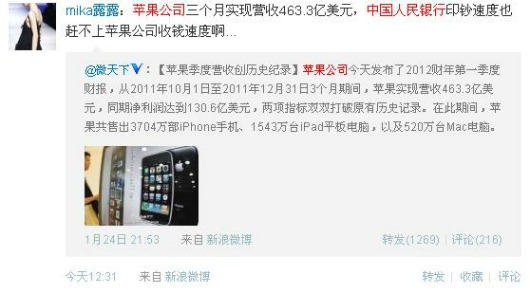
“In three months’ Apple’s revenue was $46.33 billion. I reckon that even the People’s Bank of China’s printing presses couldn’t keep pace,” joked another user.
 |
But amid the general praise, there were a few dissenting voices, pointing out that Chinese mobile operator China Unicom continues to suffer losses by heavily subsidizing iPhone handsets in a bid to attract new subscribers, and references to the fact that Apple’s profits had been built off the hard graft of low-paid Chinese workers. These were definitely in the minority, however.
One final thought on the possible implications of Apple’s China success: As debate continues to rage about whether or not China can become a genuine domestic consumption driven economy, Apple’s strong sales growth is clear evidence that, for all the talk of high savings rates and repressed consumption due to artificially low exchange rates and import taxes, China’s consumption clout is already hefty, and Chinese consumers are willing to spend. Rebalancing may not occur at the pace many in the West are hoping for, but it is also wrong to assume that China lacks consumption power.
As Andy Rothman, chief China macro strategist at independent brokerage CLSA told Emerging Markets last May, it is a misnomer to suggest that Chinese consumers are reluctant to spend:
| China is already the best consumption story on the planet by many metrics; retail sales, car sales, TV sales, the list is long,” he says. “Consumption is only small in the sense that it represents a small share of GDP growth, due to the fact that investment has grown so fast off such a large base. |
Furthermore, the multinational consumer brands and firms likely to benefit are neither concentrated at the high-end (Burberry, Louis Vuitton etc), nor at the low-end (Wal-Mart, KFC, McDonald’s), but are found across the price and demographic spectrum. The success of Apple, Zara, Uniqlo, Volkswagen and other middle-market brands in China (albeit Apple’s higher price-points in China position it at the upper end of the middle market), are evidence that retailers and brands can find success among the country’s middle-class consumers, as well as the super-rich.
Further reading:
Apple Reports First Quarter Results - Apple