
A senior Indian policy official has denied that a new definition of the poverty line in India will penalize millions of the country’s poor.
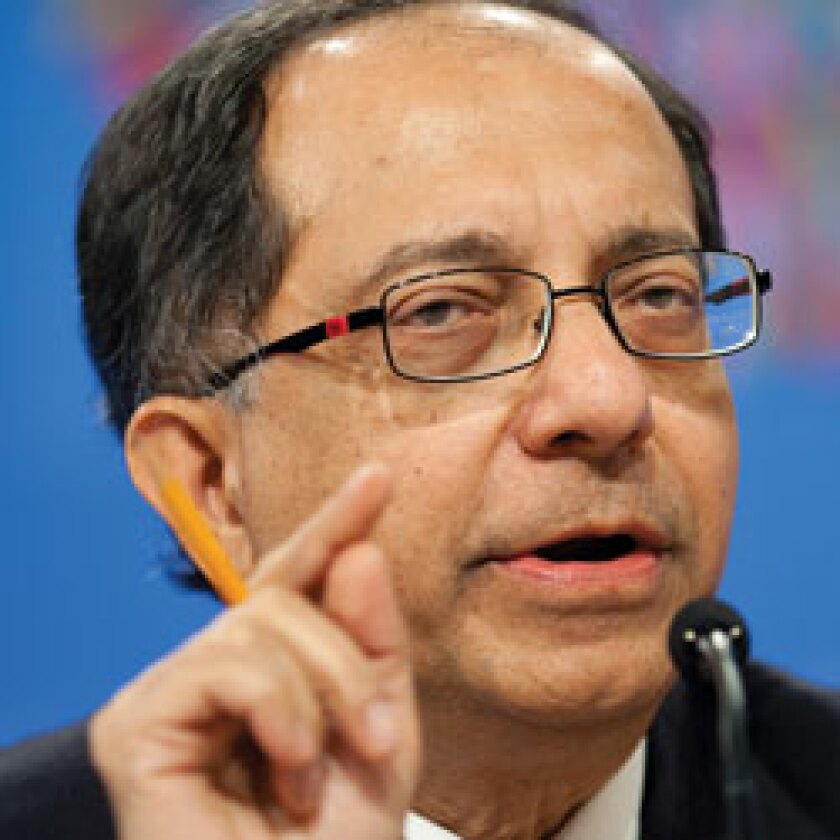
Kaushik Basu, chief economic adviser to the Indian government, was responding to a political storm ignited by a claim by the official planning commission that in rural areas only those on less than 50 US cents per day are poor.
Basu told Emerging Markets in Washington that the government had not yet decided which definition of poverty to use, and that the final definition would allow assistance to as many individuals as possible.
“We are inclined to use the most generous definition,” he said, “by which I mean a definition where more people will qualify as poor.”
Asked if the definition would impact who would qualify for food subsidies, he said: “Who will qualify as poor will certainly depend on this.”
On Tuesday the planning commission, a powerful government body that shapes economic policy, filed an affidavit with India’s Supreme Court stating that people below the poverty line are those living on below 26 rupees (around 50 US cents) per day in rural areas, and 32 rupees per day in cities.
Anyone with a higher income – including tens of millions of Indians who live below the poverty line the World Bank uses, $1.25 a day – would be ineligible for government assistance such as food subsidies.
The planning commission’s move has been widely derided as an attempt to make India appear to have less people in poverty than it does, but Basu said it was instead related specifically to a new food security programme.
He said that there are three different definitions of poverty used, and that the government did not want to “make the mistake of ... having poverty going down just by changing the definition.
“But now we are going into a new food security programme where we are going to try to reach out to a very substantial portion of the poorer population. We have data on the new definition so we can do that job better.” Previously the government’s main definition of poverty has been based on calorie intake rather than income or spending.
Amar Bhattacharya, Director of the G24 Secretariat, and an Indian national who previously advised the World Bank on poverty reduction, defended the planning commission’s move. “As long as you are consistent in the measure, I think that makes absolute sense,” he told Emerging Markets.
India’s opposition has pilloried the move. At a press conference in New Delhi yesterday, the BJP party spokesman Prakash Javadekar said the new criteria were “like rubbing salt in the wounds of the poor.”
Avinash Kumar of Oxfam India told Emerging Markets: “Estimating the numbers of people in poverty is an exercise which often ends in number crunching for the sake of justifying the government’s miserly investment in food and services for people living in poverty. This seems to be the case here.”