
Pakistan’s economy may not be booming like those of its Asian neighbours, but it has performed better than many had expected given the challenges it has faced over the past year.
Two indicators show this mixed performance and outlook for the economy: the fiscal situation has deteriorated rapidly as growth stalled and tax reforms failed to materialize, but the external position of the country has improved dramatically, on the back of growing remittances and rising export proceeds from high international cotton prices.
This mixed performance, and the rather primitive nature of Pakistan’s economic relationship with the global economy, lead many to conclude that Pakistan faces no real vulnerability to the storms hovering over the economies of the advanced industrial world.
“We are not facing a debt problem like the one that others are facing,” says finance secretary Waqar Masud. “There is a restricted amount of external debt in the overall composition of our debt, and even within that, there is very little market debt, such as Eurobonds.
“We have run into balance-of-payments problems, and for that we have been going to the IMF for some time, and that remains a concern, and we are engaged with the fund, although the current programme ends at the end of September.”
The view is echoed by others, although they add that the economy has its vulnerabilities, but these arise more from domestic weaknesses than international developments.
“Pakistan’s vulnerabilities are uniquely Pakistani,” says Salim Raza, former governor of the State Bank of Pakistan. “We’re not vulnerable through FDI or other inflows, but we need to get back on track with the IMF, on the present or a restructured programme, before repayments begin. A delay could have an impact on other multilateral inflows.”
COUNTING THE COST
The health of the external account is central to any discussion of Pakistan’s vulnerabilities to global economic turmoil. In the last financial year, foreign exchange reserves have surged to all-time highs, almost touching $18 billion. Exports and remittances, which have grown by 25% and 20% year-on-year respectively, explain most of this surge.
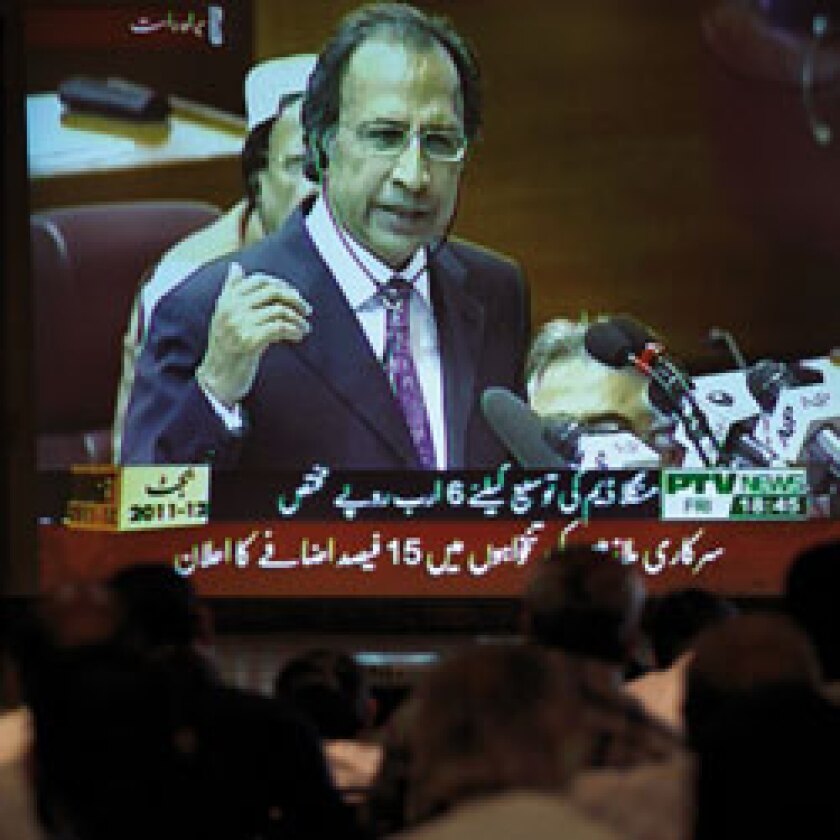
Both indicators have continued to perform well so far this fiscal year, finance minister Hafeez Shaikh tells Emerging Markets in a rare interview. “So the sort of conservative estimate that we have been playing around with – for exports to grow at only 6% and imports by about 10% – means we should be in reasonably good shape on the external account, barring anything totally unexpected or a dramatic setback on the oil price front.
“We feel that it will be a tough year, but an entirely manageable year in terms of how the external account will fare. The payments we have to make to the fund are already budgeted and reflected in these numbers.”
But not everybody is impressed by these numbers.
Farid Khan, chief executive of ABL Asset Management, one of Pakistan’s largest mutual funds, says that the day of reckoning could be fast approaching: “The external account is comfortable for now, but this window of comfort will not last long. We have six months or so to fix our fiscal position, cut down our administrative expenses, raise revenues and get a new lifeline from multilateral agencies.”
Without urgent action, Khan says there could be a “large drain” on Pakistan’s liquidity position, especially once IMF loan repayments begin, in February 2012.
“There is no plan for this eventuality. We need results like growth and investment to get moving as the wheels of the economy are not moving at all. Our external position cannot be stable in the absence of growth and a precarious fiscal account.”
Salim Raza is similarly cautious when looking at the numbers on the external account: “Are these reserves accumulating due to an improvement in the underlying strength of the economy?” he asks. “If your current account deficit is down because you’re not investing, is that good?”
Moreover, the terms of trade that have produced these high reserves can change. “For the real sector, it’s all in how our international terms of trade move,” says HafizPasha, who chairs the Revenue Advisory Council of the government, which provides input into the budget-making process, and is also a governor at the State Bank of Pakistan, “because historically our terms of trade have improved in times of global recession. Sure our exports see a dip, but recessionary times see the price of oil fall even faster, and oil is the single largest item in our import bill.”
In the last fiscal year, Pakistan’s oil imports were at $12.3 billion out of a total import bill of $35.6 billion. Pasha says oil prices are unlikely to plummet as they did following the 2008 financial crisis because of the weakness of the dollar and a “flight to quality” by international investors, in which oil investment provides a hedge against risk.
There are other concerns. Prices for cotton, Pakistan’s main export, touched Rs12,500 ($143) per unit at their peak in March, but fell to Rs6,300 by July. Oil has failed to come below $100 for any sustained period during this time.
FISCAL DEFICIT CONCERNS
But the biggest domestic source of worry for most people remains the fiscal deficit. In the 2009/10 financial year, Pakistan ran a deficit equivalent to 6.3% of GDP against an original target of 4%. Consolidated numbers for this financial year just ended have not yet been released, but expectations are that this year too the deficit will be in the same range.
The government blames the slippage on the floods and an unexpected surge in the price of oil. Although the slippage was not immense – the revenue target of Rs1,588 billion in fiscal year 2011 was only missed by Rs32 billion, according to the government.
But the growing stock of domestic debt tells a different story. “A large and persistent fiscal deficit gives you a rapidly rising domestic debt,” says Khan. “Our domestic debt grew by 29% last fiscal year. That’s way above our GDP growth rate, and most of that is short-term debt, raising rollover risk. This can become unsustainable very quickly.”
Shaukat Tarin, a former finance minister who assumed office in the midst of the 2008 crisis, agrees. “If we don’t mobilize our own resources, the fiscal deficit is going to bury us,” he says. “And given the short-term nature of this debt and high interest rates, compared to foreign currencies, there will be a compounding effect, which means our interest payments will rise disproportionately and will consume a bigger part of our fiscal resources and hence pose a threat to the economic stability of the country.”
The Asian Development Bank echoes such concerns on domestic debt in its latest report on Pakistan’s economy.
The government’s growing recourse to bank borrowing is also creating large and concentrated exposures to sovereign risk on bank balance sheets. This growing concentration of bank lending in government securities and the working capital needs of a small number of blue-chip companies is part of a hangover from the crisis of 2008, and has tied the government and the banks together in an ever closer embrace ever since.
As early as March 2009, the State Bank, in its Quarterly Performance Review of the Banking System, noted that “the asset mix of the banking system shifted away from loans and advances to risk-free government papers and government-guaranteed bonds of PSEs (public-sector enterprises). The loan portfolio (net) declined by 5.6% over the quarter while investment in government papers increased by 20%.”
Last December Moody’s downgraded the global local currency (GLC) rating of Pakistan’s top five banks, saying that “the downgrades were primarily driven by the banks’ growing exposure to (B3-rated) Pakistan government securities and government-related lending.”
According to estimates by Moody’s, Pakistan’s banks’ total exposure to sovereign-related risk assets jumped from 24% of total assets in 2008 to 38% by the end of June 2010. The agency says this represents “a material exposure concentration” and raises the banking system’s vulnerability to “event risk” in its portfolio of sovereign debt.
Today almost 50% of banks’ books consist of government debt, which suggests that at some point in the future banks could refuse to lend to government or start to demand premium yields. This may still be some way off. Yields on Treasury bills, the instrument of choice in government debt, have dropped by almost 50bp in auctions held in August.
“One act of violation on the sovereign front could mean big trouble,” says Hafiz Pasha. “It’s not just the growing amount of the debt that is troublesome, but the composition as well, with tenors getting shorter and guarantees to the public-sector enterprises also growing.”
The government insists a default is unthinkable, but says the concerns raised by Moody’s are “well taken” and that it has been trying to reduce its dependence on bank borrowing, by shifting borrowing towards non-bank sources, for instance.
Improved debt management is clearly a priority in times of growing government borrowing, says Salim Raza. “You need steps like institutional arrangements to invest part of the government deposits in the banking system into short-term government securities. But you also need steps to increase revenues, plugging leaks in the PSEs – fixing the fiscal plumbing basically.”
But efforts to “fix the fiscal plumbing” have not kept pace with the growing deficit. The outgoing fiscal year saw one of the most important fiscal measures in Pakistan’s recent history – legislation to introduce a value added tax – die a noisy death.
Following the failure to bring in VAT, this March the government resorted to subordinate legislation to withdraw the exemptions from its complicated General Sales Tax, that is moth-eaten with exemptions granted over the years.
“The tax measures we adopted in March were very significant; they had an impact on powerful and influential people, but none of those measures were reversed,” says Waqar Masud.
But the IMF had a different assessment. “Structural reforms had moved forward in late 2008 and 2009, but have been retarded or reversed in 2010 and 2011,” the IMF said in a strongly worded note in April, days before Pakistan’s finance team was due to arrive in Washington DC for the IMF’s spring meetings.
The fund acknowledged the steps mentioned by Waqar Masud, but said “this reform has been delayed and its scope has been far narrower than earlier envisaged.”
POWER PLAY
At the heart of the country’s fiscal situation is the power sector, where the stock of outstanding payables by the state-owned power company has crossed Rs280 billion. “The present budget is built around a subsidy reduction of over Rs200 billion, whereas we’ve got a huge subvention coming for the circular debt in the power sector, and fertilizer subsidy this year is going to be much larger than expected,” says Pasha. “I don’t see a plan of action on the fiscal front; there’ll be big difficulties to meet the revenue and expenditure targets of this budget.”
Finance minister Hafeez Shaikh outlines a formidable reform agenda for the power sector, insisting it must be implemented in “six to nine months” [see box]. But the government’s options are limited, since the power sector is at the heart of the growing debt difficulties, and plans for expenditure control. Moreover, the power sector is critical for a government at the beginning of an election cycle. Elections have to be held by 2013.
With an uncertain outlook on the strength of the external account, and underlying fiscal rigidities fuelling a growing deficit and recourse to bank borrowing, Pakistan has little room for complacency when regarding the storm clouds gathering over the world economy.