
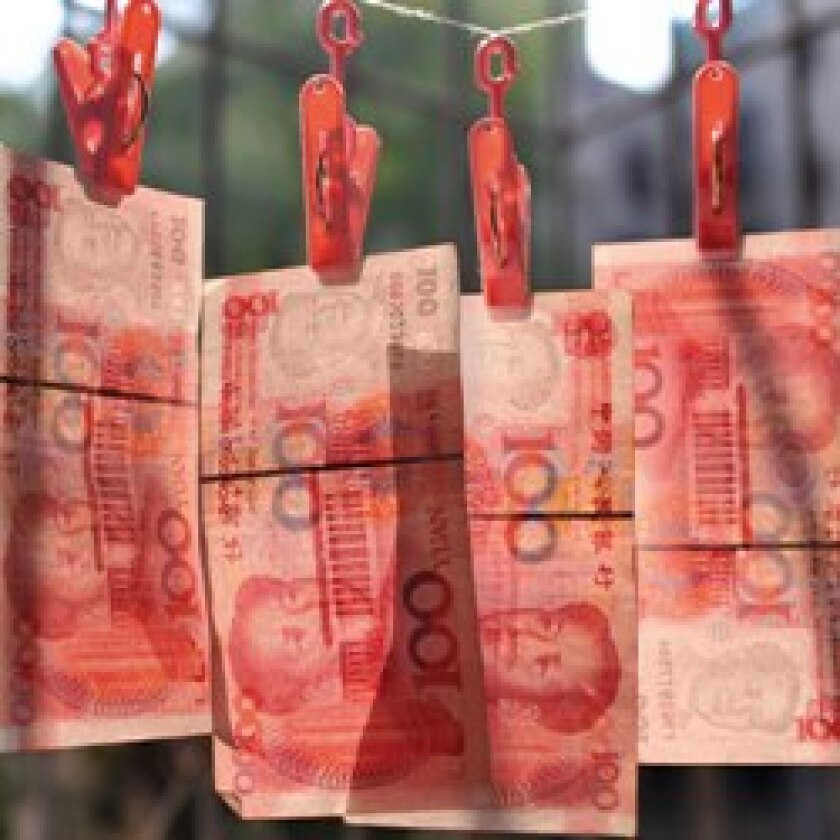
Is the Chinese renminbi the natural heir apparent to the US dollar? The question has absorbed corporate treasurers, investment bankers and the global money markets as financial markets ask whether the redback – as the renminbi is widely dubbed – is really the next big thing.
The financial crisis and its aftermath have exposed the dangers of the world’s over-reliance on a single currency. But as US economic supremacy wanes, the argument goes, so too will the dollar’s throttling hold over global trade. A consensus is emerging that a multipolar global economic order beckons, marked out by a key set of currencies – the euro, dollar, Japanese yen and China’s redback.
But amid all the talk, the renminbi remains, at its basest level, a schizophrenic totem, heavily restricted within China’s heavily guarded onshore market but relatively liberal in terms of its fungibility outside the mainland.
According to Robert Minikin, senior foreign exchange strategist at Standard Chartered Bank, “There are basically no restrictions on companies or investors holding renminbi offshore.”
Duncan Phillips, a director on Citi’s Asia Pacific debt syndicate desk in Hong Kong, says this situation offers a way for China to “internationalize their currency, without having to internationalize the country”.
Recent months have seen a moderate sum of activity but an outsized level of excitement accompanying the sale in Hong Kong of so-called ‘dim sum’ bonds – securities sold in Hong Kong but denominated in renminbi. Issues by industrial equipment maker Caterpillar and fast food giant McDonald’s have captured the headlines. China’s Citic Bank in September announced plans to raise as much as Rmb30 billion ($4.7 billion) in the offshore RMB market before the end of 2013.
In August, China’s finance ministry, in a clear attempt to bulk up the market, launched the largest dim sum to date, a Rmb20 billion ($3.1 billion) sale issued through Hong Kong to local and more than a few foreign investors.
The event was regally accompanied by a political heavyweight, Li Keqiang, the man touted as China’s next premier, who flew to Hong Kong to drink wine, glad-hand, and, in between meals, to promise that non-financial Chinese firms would soon be allowed to raise renminbi offshore.
Linan Liu, chief China rates strategist at Deutsche Bank, says Li’s visit “proves the strength of China’s resolve in pushing for the offshore development of the renminbi”.
WE’RE LOVING IT
Yet read between the lines and the finance ministry’s move is more than that. The trip was designed to reignite a sense of excitement in a flagging market. Dim sum issuance is far less than it could have been. Smallish local renminbi bond sales by a burger giant and a scattering of dutiful international financial institutions (World Bank, Asian Development Bank) hardly constitute a large, deep, liquid, thriving industry.
In fact the supply of available offshore redbacks, held mostly in Hong Kong, lags demand. Around 140 dim sum bonds worth Rmb105 billion were completed in the 12 months to end-June 2011 – but most of them were small transactions by largely unknown Hong Kong companies.
The dim sum market seems to be oddly similar in size and scale to the Hong Kong and Singapore dollar debt markets. All three markets haveissued the same quantity of local currency debt – around $12 billion – in the 12 month period until August 23.
But compare that to the far deeper pool of renminbi-denominated Hong Kong deposits, which stood at Rmb550 billion at end-June, and is tipped by most redback specialists to rise to Rmb1 trillion by year-end. Thus, for every single yuan of dim sum debt in Hong Kong there were more than Rmb5 in renminbi-denominated Hong Kong deposits.
To a great extent, a reality check is going on here, in which the true scale of the offshore renminbi market, and its potential growth as permitted by the Communist Party of China, is being reassessed.
“If you rewind to the end of last year, there was this euphoric period where everyone thought the market was going to explode,” says Citi’s Phillips. “But now issuers realize investors aren’t going to buy everything that’s put in front of them, and investors are realizng that the fees aren’t that great.”
For the market to grow, it needs better, bigger and bolder global issuers. Reuben Tucker, global head of bond origination at ANZ, says, “The demand for offshore renminbi investments is now for high-quality assets. We have seen a range of lower-grade issuers in the market, and what the market wants now is [more] issuance from the likes of McDonald’s or Caterpillar – companies with strong global brand awareness and strong China businesses.”
Yet, so far, this is not happening, for two reasons. First, most multinational corporates are waiting to see how the market develops. Says one Hong Kong-based corporate investment banker: “My clients aren’t ignoring the market, but their attitude is that until they get greater clarification on the repatriation process, they will put plans on hold.”
Citi’s Phillips says: “For now, the problem is not finding enough investors – it’s finding enough issuers to come to the market.”
TESTING TIMES
Many issuers are merely dipping their toes in the water to get a sense of the market. ANZ’s Rmb200 million, two-year dim sum, issued last December, was designed to let the bank identify any snags in the regulatory and remittance process.
This is important. The process of issuing dim sum bonds is tricky and drawn out, leading many corporates to delay the inevitable headaches caused by issuing debt through a cumbersome set of regulators at, compared to most developed jurisdictions, a snail’s pace.
The issue of repatriation is also causing particular concern. Until the process of channelling renminbi-denominated capital raised in Hong Kong into the mainland speeds up, the market is going to be constrained. The slow approval process for dim sum bonds has been a complicating factor in the market’s development, and a frustrating obstacle for sophisticated corporate issuers.
There is logic to this foot dragging from the regulators in charge of approving capital inflows – the People’s Bank of China and the State Administration of Foreign Exchange. Both are concerned that capital raised in Hong Kong will be immediately channelled back into the PRC (People’s Republic of China) to take advantage of an appreciating currency. StanChart’s Minikin says: “China wants to allow the growth of an offshore renminbi market without this leading to an inflow of hot money.”
Yet this intractability is counter-productive. China wants to create an offshore currency that is used by the wider business world, and one way this can happen is by allowing multinational corporates to raise renminbi offshore, then remit it into the mainland in the guise of foreign direct investment (FDI).
This makes sense – Beijing is not overly interested here in creating a new asset class. “In reality,” says Minikin, “the Chinese authorities want the renminbi to be used in foreign trade invoicing and settlement, and more generally as a measure of value that can potentially rival, or even replace, the dollar.”
And, again, what better way to do this than by allowing FDI capital to be invested and reinvested back into China by reliable foreign corporates.
It is also worth looking at other obstacles to the market’s development. “If we drill into the market a little, we find that it has grown very quickly without a supporting infrastructure,” says ANZ’s Tucker.
“There is no short-term reference rate, no defined money market, and limited liquidity in the swaps market in terms of volume and tenor.” All are financial instruments to be found in most developed markets (including the local and global market for the Hong Kong dollar).
Another obstacle is the paucity of competing offshore renminbi-based options for investors. Just one equity-based issue has been completed since the offshore redback market was opened: the April 2011 IPO (initial public offering) of real estate investment trust (Reit) Hui Xian.
Yet despite offering investors both a blue-chip owner – Hui Xian is controlled by Hong Kong billionaire Li Ka-shing – and, with a higher return than Hong Kong dollar-denominated Reits, providing a compelling option for yield-hungry investors, the sale was largely a bust.
Hui Xian’s sale was completed at the very bottom of the price range, and each unit, sold at Rmb5.24, was trading on August 23 at Rmb4.21.
LESSONS OF HISTORY
Yet do the contradictory differences between the onshore and offshore renminbi, for now, really matter? The economic giant of Japan, despite being one of the fastest-growing economies in the 1970s and 1980s, didn’t open a single yen market until the early 1990s (and where the offshore market disappeared overnight).
Chinese officials say the same route should be followed – and this path will create a single Chinese currency, open to all, without any of this offshore-onshore circumlocution. And for a timetable? Probably somewhere in the early 2020s, observers reckon.
At that point the redback will be fully fungible, with trading likely focused on four financial hubs: Hong Kong, Singapore, London and New York.
“Over the fullness of time, the renminbi will take its rightful position as an international currency,” says ANZ’s Kelly. “It won’t perhaps become a reserve currency, but it will be one that reflects its position of influence alongside the euro and the US dollar. I would say this is a good thing.”
In terms of foreign corporates raising capital in renminbi, that is just a matter of time. The redback is already gaining in acceptance at the institutional investor level – up to 25% of the finance ministry’s August dim sum bond was bought by investors in Singapore, Europe and North America. At the corporate level, most pan-global multinationals have a well-developed long-term renminbi financing strategy in place – even if they have not, as yet, done anything about it.
So much still needs to happen to create a single, fungible Chinese currency that means the same to a small corporate in Hunan province as it does to a wealth manager in London or Frankfurt. That will take years, perhaps more than a decade.
Japan took its time, hoping to get things right. China’s neighbour, South Korea, has never fully opened its currency, the won, to the world.
China wants to turn the redback into a global currency, but it will take its own time about doing things. That much is already clear.