

 |
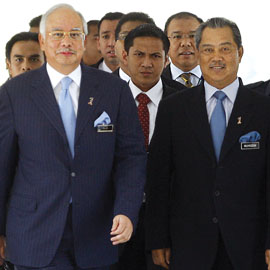
Najib Tun Razak, Malaysia’s finance minister who, true to Malaysian political tradition, also happens to be its prime minister, has a tricky year ahead. Traditional political dynasties and norms are falling apart; being an aristocratic Anglophile Malay is no longer enough to assume the highest office. Moreover, Malaysia has changed much since Najib’s father, Tun Abdul Razak, was prime minister. Economically, the country, south-east Asia’s most advanced economy after neighbouring Singapore and one striving for official developed status by 2020, is targeting OECD (Organization for Economic Cooperation and Development) membership.
However, this means that Najib must even out income distribution in this lop-sided nation. It is a goal made harder still against the backdrop of an export-led economy more vulnerable to external shocks than many in Asia and where fears remain of a re-run of the 2008 crisis among Malaysia’s main trans-Atlantic trading partners.
Parts of the country – notably the industrialized and trade-focused Klang Valley around the capital Kuala Lumpur – would easily qualify for developed status. But this wealthy region’s GDP per capita of $33,000 is in sharp contrast with Malay-centric states like Kelantan just a few hundred kilometres away, whose two million people earn just $3,000 annually.
Politically too, Malaysia is evolving from the gerrymandered, Malay-ruled autocracy of the 22-year-long era of Tun Razak’s successor Mahathir Mohamed, to something approximating a democracy.
This is challenging ground for Najib and his United Malay National Organization-led (UMNO) coalition, which has ruled Malaysia since independence in 1957. Having made their point in the 2008 election, when Malaysia’s once-irrelevant opposition captured a record half the vote, near 40% of parliamentary seats and control of key economic states like Penang and Selangor, Malaysians are demanding change and are calling their leaders and the politicized civil service to account as never before.
REFORMASI
In the midst of all this, the institutionalized primacy of Najib’s ethnic Malay community as enshrined in the so-called New Economic Policy (the controversial decades-old affirmative action programme that advantages his fellow ethnic Malays) is coming apart. The NEP was conceived by Najib’s father and finessed into an ideology under Mahathir. But since Mahathir stepped down in 2003, Malaysians of every ethnic persuasion have tasted reformasi, and more and more are discovering they like it, and would like more.
Just a year after being handed office in Malaysia’s traditional fashion – anointed by the party faithful instead of the ballot box – Najib can’t claim an all-important electoral mandate to advance sorely-needed reform.
In an earlier time, that wouldn’t much have mattered. But Najib is bowing to the ballot box, and to opinion polls that show 71% of Malaysians think the New Economic Policy is obsolete.
Najib appears to take that line too. In his pitch to bounce Abdullah Badawi from the ruling UMNO leadership, after the party’s disastrous 2008 election showing, Najib told the UMNO faithful that “if we do not change, the people will change us”.
Now in office, Najib has proposed sweeping reforms across the economy, overhauling the NEP that was designed to bring the economic status of the majority and mostly rural Malay community, 55% of Malaysia’s population, in line with the more commercially oriented ethnic Chinese and Indian minorities. The ambitious new programme, dubbed the New Economic Model, seeks to make Malaysia a high-income economy with developed nation status by 2020.
In an interview with Emerging Markets in May, just weeks after the new reforms were unveiled, Najib expressed confidence in his ability to push them through – despite concerns locally that they could cost him his job.
“I feel strongly that my government has the necessary support to push our reform initiatives forward,” he says, adding that Malaysians would demand reform. “They desire a massive transformation.”
But how Najib proposes to wean Malaysia off the NEP remains hazy. Its impact on the economy is uncertain – some liken it to a national deregulation unleashing entrepreneurship, while others believe it could impoverish half of an already unevenly wealthy population.
Electorally, it’s also fraught. Najib’s ruling coalition lost its two-thirds majority in 2008 that gives it legislative carte blanche. He risks losing more if Malay voters rooted on to decades of NEP perks turn away from him. As a counterbalance, Najib stands to gain from swing voters who sent UMNO a stern rebuke in the 2008 election.
Najib doesn’t have to go to the polls until 2013, but he’d like the electoral authority to embark on his reform drive sooner. Najib told Emerging Markets in May: “I agree this is no easy task.” But “Malaysia’s future prosperity depends on our ability to create an environment conducive to innovation and investment. The NEM... depends on our ability to provide equitable treatment for all businesses, ethnic communities and groups.” He said the NEM will “be based on needs and merit, and not simply race”.
It helps his case that the economy is ticking along nicely. Central bank governor Zeti Akhtar Aziz announced in August that Malaysia’s economy had expanded by an annualized 8.9% in the second quarter, this after the 10.1% expansion in the first three months.
ECONOMIC SLOWDOWN
A confident Zeti told Emerging Markets in an August interview that these two quarters are the best performance by the Malaysian economy since the first quarter of 2000, when the economy rebounded from the lingering effects of the late-1990s’ Asian financial crisis to jump by 11.7%. “We are seeing a pick-up in investments, consumption is strong, and our domestic economy remains strong and robust,” she said.
The strong showing has Malaysian economists re-jigging their forecasts while speculating about possible election dates. Surprised by the stronger than expected second quarter numbers, the influential chief economist at Kenanga Investment Bank, Wan Suhaimi Saidi, has upgraded his 2010 GDP forecast to 6.8% from an earlier 6.3%.
But he worries about the consequences of a slowing world economy next year for Malaysia’s export-led economy, where the ratio of exports to GDP is about 100%. Though demand from China is steadily replacing Malaysia’s traditional western markets – China now buys 12% of Malaysia’s output, six times the level of the mid-90s – Suhaimi estimates 2011 GDP growth at 5.5%, as demands growth slows in the second half.
“This would suggest that Najib will be encouraged to go to the polls sooner rather than later,” he says. Suhaimi says all eyes are now on upcoming elections in Sarawak state, which must be held before mid-2011. Former finance minister and UMNO powerbroker Tengku Razaleigh Hamzah has said that the UMNO-led coalition will need to secure a two-thirds majority to give it national comfort.
At CIMB, chief economist Lee Heng Guie forecasts growth to cool to 5.1% in the second half of 2010. “Faced with the slow global recovery, including rising odds of a sputtering recovery for the US and a cooling off in China’s demand, Malaysia’s exports will continue to weigh on overall GDP growth.
“This, together with the normalization of low-base effect will result in a slow GDP growth.” CIMB forecasts 2010 GDP growth to come in at 7.0%, slowing to 5.5% for 2011.