

 |
| Any relief? |
Pakistan’s economic distress, triggered by the floods this summer has radically altered what appeared not too long ago to be a gradually stabilizing economic picture. Earlier this summer, prime minister Yusuf Raza Gilani had reason to be cautiously optimistic when Pakistan’s budget for the new financial year (July-June) was presented by finance minister Abdul Hafeez Shaikh. At that time, a cabinet colleague recalls Gilani saying that “economic growth may be slow, but some of the conditions will improve down the line. Maybe the crops will yield better results.”
But less than three months into the financial year, Gilani is leading the sceptics, worried that Pakistan’s economic outlook descending into chaos after the heavy monsoon rains and devastating floods that caused widespread destruction.
For Gilani, himself a farm owner, the worst affected part of the economy is agriculture – which directly or indirectly provides jobs to more than half of Pakistan’s population. The prime minister believes the losses could be worth a staggering $43 billion, though western economists put the estimate more conservatively between $8-15billion.
Whatever the final toll, it is clear that the losses have set Pakistan’s economy back significantly.
The floods have forced the government to scale down expectations of Pakistan’s overall economic growth to a range as low as 0-0.5% in the financial year, sharply below a target of up to 4.5%. Annual inflation is expected to jump to more than 18%, up from a target of below 10%.
The key challenges include an expected contraction of agriculture by more than 8%, after more than a quarter of Pakistan’s farmland was flooded and some of the main crops destroyed.
The losses from agriculture have wider repercussions for Pakistan’s economy, including trade and current account deficits that will be significantly higher due to increased food imports, and a budget deficit expanded by emergency government subsidies to put farmers back to work.
The economic loss will translate into “massive job losses” affecting thousands of families’ incomes, which may have serious social implications”, Gilani told his cabinet colleagues recently. He said that the overall performance of agriculture will be “much lower” this year and next year.
Gilani added that the loss would have a snowball effect on manufacturing, services and export sector.
The latest crisis has thrown up substantial challenges for an economy already reeling from years of mismanagement, corruption and the fallout from Pakistan’s ongoing campaign against Islamist militants.
At issue is also the future of Pakistan’s relations with some of its main foreign lenders, notably the IMF. In late 2008, Pakistan was forced to sign a two year loan of just over $10 billion, to tide over an expected balance of payments crisis.
Even though the loan disbursement will be completed only by the end of 2010, the economic losses from the floods have added to Pakistan’s economic and financial woes.
After the floods, the government began negotiations with the IMF, either to ease conditions tied to the existing loan or to refinance it with a new loan with easier terms. But evidence of economic performance already off-track – even before the flood-related losses – has unleashed strong criticism from western economists based in Islamabad over Pakistan’s chronic failure to reform its economy.
A planned new general sales tax (GST) to replace an inefficient existing indirect tax continues to be delayed after the government failed to enforce it on July 1, in spite of promises to the IMF.
The fiscal deficit for the last financial year (July 2009-June 2010) rose to 6.3% of GDP, up from the government’s target of 5.1%, in an indication of continued mismanagement.
At the heart of the challenge lies a long-term failure to reform Pakistan’s tax collection infrastructure, which has contributed to the missed targets for the fiscal deficit. In a country of about 180 million, less than one percent pay income tax and tax collectors repeatedly focus on this narrow group.
Market participants warn that without a forceful effort at financial prudence, the economy will deteriorate further. “Unless the fiscal issues are resolved conclusively and the budget situation improves and improves once and for all, Pakistan’s economic outlook will go through periodic challenges”, says Shuja Rizvi, head of sales at Crosby Markets in Karachi.
“Pakistan’s economic challenges may have been aggravated by the floods, but many of these challenges precede the floods” adds Mr Rizvi.
According to Ehtisham Ahmad, a senior visiting fellow at the London School of Economics, the slippage from the GST reform in June 2010 – which should have led to its introduction from July – was a breach of the main conditionality underpinning the current Standby Arrangement (SBA) with the IMF.
Ahmad, who stepped down as senior advisor to the IMF’s board in December 2009, says this lapse dents the government’s credibility: it had itself proposed the measure in September 2008 to the Friends of Pakistan, an international coalition of Pakistan’s allies, and it was not imposed by the IMF at the outset of the programme that followed subsequently.
Together with the fiscal hole due to the delays in adjusting energy pricing, the GST slippage means that the IMF programme was off-track even before the floods devastated the economy, Ahmad adds.
While IMF support for disaster relief could be applied for via a simple letter from the government, it is clear that the full discussions on the review of the programme were not completed in Washington in September when Abdul Hafiz Shaikh, Pakistan’s finance minister, travelled to plead Pakistan’s case to the IMF.
Ahmad says: “There is now a significant risk that the programme will lapse, without further drawings. It is also clear that there will be a need to negotiate a new programme to ensure that the repayments to the Fund due from 2011 can be made with minimal disruption.”
In the light of the IMF’s programmes for other countries such as Greece, analysts warn it is inconceivable that any new programme that will be as accommodating as the current Standby Arrangement.
The need to mobilize domestic resources, especially after the floods, has also prompted finance ministry officials in Islamabad to plan for a one-time tax for flood relief on members of Pakistan’s most affluent classes.
President Asif Ali Zardari has convinced the southern province of Sindh, of which the sprawling city of Karachi is the provincial capital, to take the lead in taxing homes of affluent people to raise money for flood victims, while he has said that he plans to enforce a similar tax in Islamabad, the federal capital.
Given that this tax is meant to be applied by Pakistan’s provinces, Zardari is now urging other provinces, notably the populous Punjab, to follow suit.
But the idea of taxing those who are already in the tax net is controversial. Shaukat Tarin, Pakistan’s former finance minister, who resigned in February this year citing personal reasons – but amid speculation that he had differences with Pakistani leaders on tax reforms – warns that the effort may backfire.
Tarin says: “If you fail to further document this economy, and start applying more taxes to the same people who are already in the tax net, you are at the risk of taking a provocative tax.”
Tarin won’t discuss the circumstances which led to his resignation. But according to a senior finance ministry official, Tarin’s differences with Pakistan’s political leaders became irreconcilable over the issue of about 770,000 people documented by Pakistan’s tax officials who bought new cars and new properties in the past five years but were not registered as taxpayers.
“It was clear to Tarin that it was time for him to go, when he was blocked from going after this clear case of widespread tax evasion,” remembers one finance ministry official.
While it is still unclear whether Pakistan’s leaders will be willing finally to step aside and allow sweeping reforms in critical areas, the floods have only stepped up the urgency for such reforms.
Hafeez Pasha, the former commerce minister and currently head of the Lahore-based Institute of Policy Studies, says the number of people living below the poverty line will likely rise to 40% of Pakistan’s population, up from about 33% before the floods. “This is a desperate situation which needs urgent measures” he tells Emerging Markets.
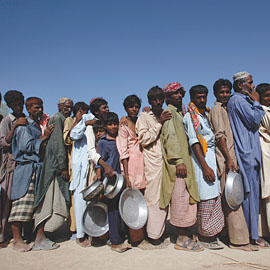
Pasha’s words of warning resonate with Salim Khattak, an impoverished farmer, camped in a tent with his wife and nine children outside the northern city of Peshawar after being forced out of his village home in the floods.
“I lost my crop and my cattle in the floods. Now, I have to live on the generosity of others and I just don’t know if and when I will ever get back on my feet,” Khattak says, holding back tears as a group of his fellow flood victims rush from a nearby camp to meet a relief truck carrying food packs.