Pre-migration untagged articles
-
The primary and collateralized loan obligations will be marked by weak issuance in 2009, investors say. But market players still tout the inherent value of the asset class and expect market players to continue to look at the secondary market.
-
A look at bids and the events that brought them down.
-
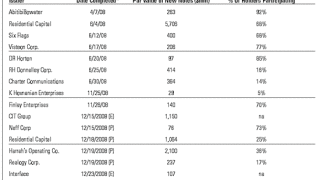
 Low bond and loan prices and a bleak refinancing climate saw more and more companies attempting distressed-debt exchanges, in which the company issues lenders a lower principal amount of new debt in exchange for outstanding debt. The exchanges can reduce leverage and save issuers from looming interest payments and near-term maturities. Interest in the exchanges has varied widely depending on the interest rate increase offered as well as perceptions of the company's viability, among other factors.
 -
Tighter credit has dialed up the difficulty of securing debtor-in-possession loans used to finance company operations and reorganize during a Chapter 11 bankruptcy. "That market in particular has become extremely tight--and that's an understatement," said James Sprayregen, a restructuring expert and partner at law firm Kirkland & Ellis. "The DIP market is virtually dried up. If there is a DIP to get done it's at extraordinarily rich pricing." Most DIPs that are getting done are what he called defensive DIPs--loans made by investors who are already in the credit and are essentially putting up new money to protect their investment. Tribune Co. received defensive bankruptcy financing from existing lender Barclays Capital earlier this month. A Tribune spokesman declined to elaborate on the bankruptcy financing. A Barclays spokesman delined to comment.
-
Market players do not think the secondary market will rebounded any time soon, but they are predicting an eventual recovery. Investors who enter the market now will probably reap returns of 15-20% over the next few years, according to Bob Franz, head of sales and trading at Credit Suisse. "People are rushing out of the asset class exactly when people should be pouring into the asset class," he said.
-
Stability in the cash loan market is needed to improve volume in the single-name, loan-only credit default swap market. The LCDS market has seen volumes shrink amid the current credit crisis. A new non-cancelable contract is expected in possibly January or February, which could help improve liquidity, but the underlying product has to stabilize before the derivative market can improve.
-
Chrysler Automotive's first online public service announcement must have made enough of a splash--and not just because of its neon-green font--to prompt the car company to follow up with an encore.
-
* JPMorgan bested Credit Suisse in a series of semi-athletic, fully-alcohol-related games last Thursday at Slate bar in Manhattan. The loan sales, trading and capital markets teams from both banks faced off in bouts of foosball, beer pong, pool, pop-a-shot and other games. The final match was a boat race with about 15 bankers lined up with a glass of beer at their feet. Each team member cannot start his beer until the teammate before him finishes his. JPMorgan won that race by nearly a beer-and-a-half and the group literally broke out in song and dance, singing, "Ole! Ole, Ole, Ole!" Said one Credit Suisse banker about the night's events: "We got destroyed" (CIN, 6/2).
-
Banks not willing to lend warehouse lines, a lack of equity investors and a lack of triple-A buyers hurt the collateralized loan obligation market in 2008, and that weakness is expected to continue in '09. Also affecting the market is the ability to buy tranches cheaper in the secondary market.
-
Secondary market trading volume hit a record high of $146 billion while average mark-to-market prices fell to 95.32.
-
--Bob Franz, head of sales and trading at Credit Suisse, on the value of the loan asset class.