Currencies
-
 Covered bonds may have caused a growth in mortgage lending and an increase in house prices that now pose a threat to the stability of the Norwegian financial sector, the country’s financial regulator said on Tuesday. To address the risk from the rise of secured funding, Norway’s Financial Supervisory Authority is debating whether to follow other jurisdictions and impose limits on covered bond issuance.
 -
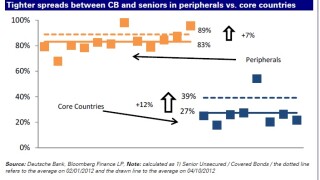
Core covered bonds are performing poorly, with low coupons putting investors off, according to Deutsche Bank analysts. Higher yielding peripheral paper could benefit as a result, but the prospect for fresh benchmark trades from southern Europe remains uncertain.
-
Investors are cash-rich and covered bond spreads look set to remain fairly stable – ideal conditions for covered bond issuance. However, deal flow is set to remain quiet as most issuers are well funded, and those that could do deals are about to enter blackout period.
-
French and German covered bonds have outperformed sovereign and agency debt from the same countries, and investors would now benefit from switching out of covered bonds, Barclays analysts have advised. But traders countered that a dearth of new issuance is preventing such profit taking, and will help keep core covered bond spreads tight in the short term.
-
Nearly a quarter of Spanish mortgages could be in negative equity, Moody’s has warned, but with Cédulas collateral marked at historic levels, investors have little transparency on the value of their claim. An updated covered bond structure is fully warranted, but unless it was legally enshrined, the benefit would be negligible, reports The Cover.
-
Terra Boligkreditt has mandated for its third covered bond benchmark of 2012. Strong collateral growth and larger funding needs mean it could launch its first ever jumbo trade later this month, said syndicate leads.
-
The transfer of assets to the proposed Spanish Asset Management Company (AMC) could hit Cédulas noteholders, as it would reduce overcollateralisation. However, as issuer defaults would become less likely, covered bondholders would stand to benefit.
-
Norddeutsche Landesbank could open books on a debut dollar covered bond as early as Tuesday morning, said syndicate leads on Monday. But the outlook for a first sterling trade from Deutsche Pfandbriefbank is more uncertain.
-
DexMA, the French local authority funding entity, has told The Cover that it will return as an Obligation Foncière issuer next year, after it is sold, subject to European Commission approval, to a group of shareholders, including the French State, La Banque Postale and Caisse des Dépôts. This follows the news that its former parent, the troubled Belgian issuer Dexia, has now fully complied with EC requirements to offload subsidiaries, after the sale of its Luxembourg unit, following earlier disposals of its Turkish and RBC Dexia businesses.
-
Covered bonds are highly liquid instruments and should be eligible for the top level of Basel III’s Liquidity Coverage Ratio, according to the European Covered Bond Council.
-
Despite growing concerns that a Spanish bad bank will cause collateral pools to shrink, there is a growing sense of confidence that real money Cédulas investors will not become forced sellers as bonds hold the investment grade rating threshold and the ECB dampens systemic risk fears.
-
With peripheral concern resurgent, covered bond investors are looking for safety. But having grown tired of exceptionally tight core levels they are also in search of spread. Nordic issuers are best placed to offer them both and should be taking advantage of the primary while they can, said syndicate bankers.