Covered Bonds
-
 Covered bonds rated AA- or higher will be elevated to a Level 1 asset in Liquidity Coverage Ratio (LCR) according to an internal document being circulated at the European Commission. This backs up a press release from the Danish government last Friday. The improved structural bid is most likely to affect bonds lower rated bonds previously ineligible for the LCR, said analysts.
 -
Depfa Bank plc will not be sold to an unrated entity, but will be transferred to the German government’s wind-down institution for Hypo Real Estate Holding, FMS Wertmanagement (FMSW). The issuer’s covered bonds tightened by around 60bp on Wednesday from Tuesday’s open as uncertainty over its future was removed.
-
The Norwegian Ministry of Finance on Tuesday defined what it considers a systemically important financial institutions, and said they should hold 2% more common equity tier 1 (CET1) than other Norwegian banks.
-
A prospective amendment to the German Pfandbrief Act will give the German regulator the authority to decide on the minimum level of overcollateralisation (OC) that Pfandbriefe issuers require. This will be decided on a case-by-case basis, could well be above the current legal minimum and will give stronger investor protection than private contractual commitments.
-
Many Portuguese covered bonds could have their ratings upgraded soon, after Moody’s raised the Portuguese sovereign rating last Friday. Banco Santander Totta’s most recent deal, which is a strong candidate for upgrade, was trading 8bp tighter from last week on Monday, but this was due to ECB rate cut hopes, and not credit upgrade hopes.
-
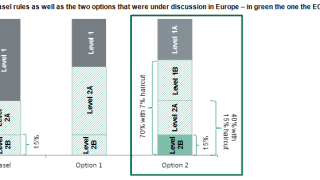
A new draft recommendation from the European Commission (EC) that appeared on the Danish government’s website on Friday says covered bonds which meet certain criteria can be considered extremely liquid assets and can fulfil up to 70% of bank liquidity buffers with a 7% haircut.
-
Spain’s Kuxtabank is on the road next week, marketing its first Cédulas since January 2013, and there are high hopes that several other covered bond issuers will make an appearance.
-
The Swedish Financial Supervisory Authority (FI) on Thursday introduced tighter capital requirements for four major Swedish banks. FI intends to activate a countercyclical capital buffer and has said it will increase the risk weight of mortgages to 25% from 15%, in line with a central bank recommendation.
-
Depfa ACS's bonds could go on to trade tighter than any other Irish covered paper as the names of the failed bank’s preferred bidders emerged. The prospective buyers' strong rating suggests Depfa ACS's rating is safe, and even if a sale is not agreed, the German government’s continued ownership means the rating is protected.
-
The European Commission (EC) could be ready to lift the amount of covered bonds that can be used to fill Liquidity Coverage Ratio (LCR) requirements from a maximum of 40% to 60%, according to the head of the Danish Mortgage Bankers Federation. The outcome could be known within a few days.
-
The Italian Banking Association (ABI) conference kicked off in Milan on Wednesday, where participants discussed amendments to the Obbligazioni Bancarie Garantite framework and considered ways to induce SME lending with reference to the newly proposed Obbligazioni Bancarie Collateralizzate framework and the ABS market.
-
The covered bond market was in good shape on Wednesday as bankers reported renewed interest in peripheral names and the multi-Cédulas sector. The primary market is expected to pick up next week as Scandinavian and German issuers line up.