
Asiamoney (AM): What have been the most important financial developments in Hong Kong over the past 25 years?
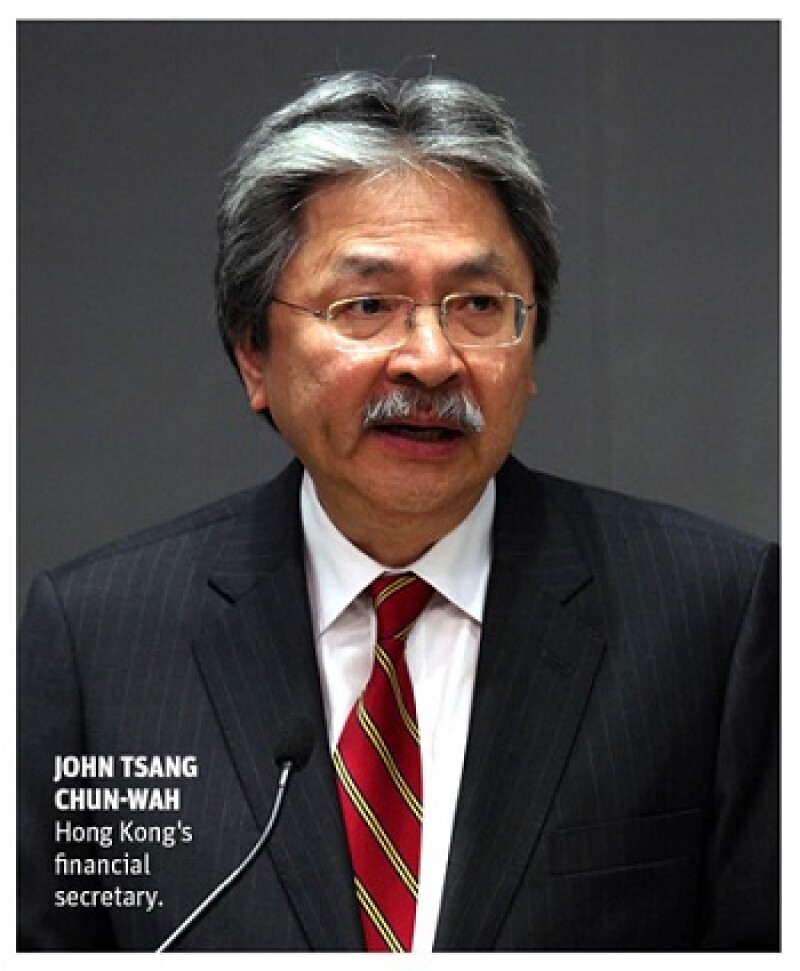
John Tsang Chun-wah, financial secretary's office (FSO): Over the past 25 years, Hong Kong has developed into one of the most influential global financial centres.
The Securities and Futures Commission (SFC), a statutory body with wide-ranging powers of regulation over the securities and futures business, was established in May 1989. The year 1993 saw the first ever H share listing, for Tsingtao Brewery.
Reforms in 1999 led to the merger of the five market operators in Hong Kong to form Hong Kong Exchanges and Clearing (HKEx), which then listed in June 2000. The Securities and Futures Ordinance came into force in 2003, bringing the securities businesses of banks to meet the same fit and proper criteria as those for intermediaries licensed by the SFC.
The offshore RMB business started in 2004 and Hong Kong has developed into the world's largest offshore RMB business hub. At the end of February RMB deposits and outstanding RMB certificates of deposit totalled more than Rmb1.1tr, or 70% of offshore RMB liquidity. RMB trade settlement conducted through Hong Kong banks last year exceeded Rmb3.8tr, up 46% year-on-year. Through the development of RMB bonds, loans and equity products, Hong Kong has become the largest offshore RMB financing and asset management centre.
In April 2014, the central government announced mutual stock market access between Hong Kong and Shanghai. This is mutually beneficial. Stock Connect will help increase the participation of institutional investors in the Shanghai securities market, enabling mainland investors to invest in overseas markets in an orderly way and promote the RMB's internationalisation.
It will also strengthen the strategic co-operation between the Hong Kong and the mainland markets, catalyse the two-way RMB fund flows between the onshore and offshore markets, and increase Hong Kong's position as the premier international financial centre and offshore RMB business centre.
Hong Kong’s financial sector could not have attained its achievements through the domestic sector alone. The key has been to forge extensive and strong ties with the rest of the world and translate the strengths of other economies to become our own.
AM: China intends to make the renminbi fully convertible soon and to continue liberalising its capital restrictions. How will Hong Kong avoid becoming marginalised by this process?
Tsang, FSO: Hong Kong has a unique advantage of being 'part of China but outside the Mainland'. I believe that full convertibility of the RMB and China’s capital account liberalisation will provide great opportunities for further strengthening the status of Hong Kong as an international financial centre.
For instance, with the liberalisation of the capital account, more mainland residents will be allowed to invest in overseas markets, and it is expected that Hong Kong will be the main destination and springboard for such investments.
Foreign investors may also invest more in the mainland market. More financial institutions and fund management companies will set up a presence in Hong Kong, facilitating the further development of financial services in Hong Kong, such as asset management and custodian services.
In addition, the increasing use of RMB in international finance, trade and investments increases will facilitate the development of offshore RMB business in Hong Kong, which will benefit banking and other forms of financial intermediation.
AM: Shanghai is vying to raise its international financial profile too, as witnessed by the city's free trade zone. How threatening is this to Hong Kong?
Tsang, FSO: I think Hong Kong and Shanghai play different roles in promoting the development of RMB business. Shanghai is the largest onshore RMB market and Hong Kong is the largest offshore RMB market, so the two cities are highly complementary.
With the establishment of the Shanghai Free Trade Zone, there will be more opportunities for co-operation between Shanghai and Hong Kong. In particular, the expansion in the cross-border use and circulation of RMB funds will further promote the internationalisation of the RMB. As the world’s largest offshore RMB business centre, Hong Kong will also benefit from its wider use.
AM: Will the Hong Kong dollar exist in 25 years' time? If so, do you think it would continue to be pegged to the US dollar?
Tsang, FSO: I am sure that the Hong Kong dollar will continue to exist. The Hong Kong dollar is the legal tender in Hong Kong, and this is stipulated in the Basic Law.
Moreover, we firmly believe that maintaining the Hong Kong dollar exchange rate stability against the US dollar under the Linked Exchange Rate System (LERS) will continue to be the most appropriate monetary arrangement for Hong Kong, given the small and externally oriented nature of the Hong Kong economy, its role as an international financial centre, and the predominance of the US dollar in international trade and financial transactions.
The LERS is simple, transparent and well understood by the public and market participants. It not only helps reduce the foreign exchange risk faced by importers, exporters, international investors and fund raisers, but also provides Hong Kong with a firm anchor to deliver monetary and financial stability through economic cycles as evidenced in the past 30 years. We have neither the need nor the intention to change the LERS.
Theoretically, with a floating exchange rate regime, the central bank can raise interest rates or let its currency appreciate to mitigate inflationary pressures. But the experience of many emerging market economies shows that the resulting widening of interest rate spreads or appreciation of domestic currency might heighten speculation around further currency appreciation, attracting capital inflows and hot money, and thus weakening or even offsetting the effectiveness of monetary policy tightening.
In face of volatile capital flows, Hong Kong could see large fluctuations in the HK dollar exchange rate if a floating exchange rate regime were adopted. This is not conducive to our external trade and cross-border investment.
AM: How should Hong Kong further diversify and broaden its economy over the coming years?
Tsang, FSO: Hong Kong’s economy is already quite diversified. We have four traditional pillar industries — trading and logistics, financial services, tourism, professional services. They contribute about 60% of Hong Kong’s GDP and employ over 1.7m people.
These four pillar industries are very competitive and recorded a cumulative growth of 84% over the past 10 years up to 2012. They are the linchpin of Hong Kong's economy and will continue to play a pivotal role.
We will continue to consolidate and strengthen these pillar industries and reinforce Hong Kong's position as a commercial hub, a financial centre and an international tourist destination.
That said, we have not lost sight of the need to nurture new industries that have potential and international competitiveness, so as to open up more new opportunities for our future economic development.
The government will provide an enabling environment and proper financial support for universities, research and development organisations and industry to conduct research and commercialise their innovations. We are refining the Innovation and Technology Fund.
We will also create a better ecological environment for technology start-ups, in collaboration with local R&D institutions and universities, and to provide various incubation programmes and support services for the start-ups.
Perhaps more importantly, we are supplying more land for commercial purposes. This will expand our economic capability and reduce the cost of doing business in Hong Kong.
AM: What will be the key differences of the Hong Kong economy in 25 years' time and how will these changes affect the government's revenue gathering and spending plans?
Tsang, FSO: A key challenge that our economy will have to overcome is an aging population and a shrinking workforce. About 75% of the total population fall within working age today; this would drop to 60% 25 years from now. Those aged 65 and above account for about 14% of the total population today; their share would rise to 30%.
Demographic changes will be a drag on economic growth. The state of the economy by then would depend on how well we can overcome growth constraints and promote new windows for opportunities in the years to come.
An aging population will add pressure to public expenditure. If we do not do anything to reduce the anticipated fiscal pressures, a structural deficit will be unavoidable. As a responsible government, we would not let this happen. We would take resolute action on all fronts and consider all policy options to manage expenditure growth, stabilise revenues and accelerate economic growth.
AM: What are the most important lessons you have learned during your time to date as secretary of finance for Hong Kong?
Tsang, FSO: Employment provides stability, both to the individual and the society at large. I am relieved that despite the difficult global economic situations in the past few years we have been able to maintain full employment in Hong Kong.
I believe that the fiscal stimulus packages that I have adopted in the past few years have played a part to maintain the momentum of local consumption and, in turn, keep our unemployment rate at a low level. The packages also help to alleviate the full impact of inflation.
The measures are mostly one-off and time-limited. They will not have long-term implications on our fiscal position. AM