
Asiamoney (AM): How has the role of your central bank and that of central bank governors changed over the past 25 years?
Amando Tetangco, BSP: The role of central banking and central bank governors has changed with the evolving needs of the global economy. The last 25 years were dominated by a period of low volatility in business cycles, low inflation, and generally predictable policies. But this was punctuated by the global financial crisis (GFC) of 2007-2008, which changed the global economic landscape and the role that central banks play.
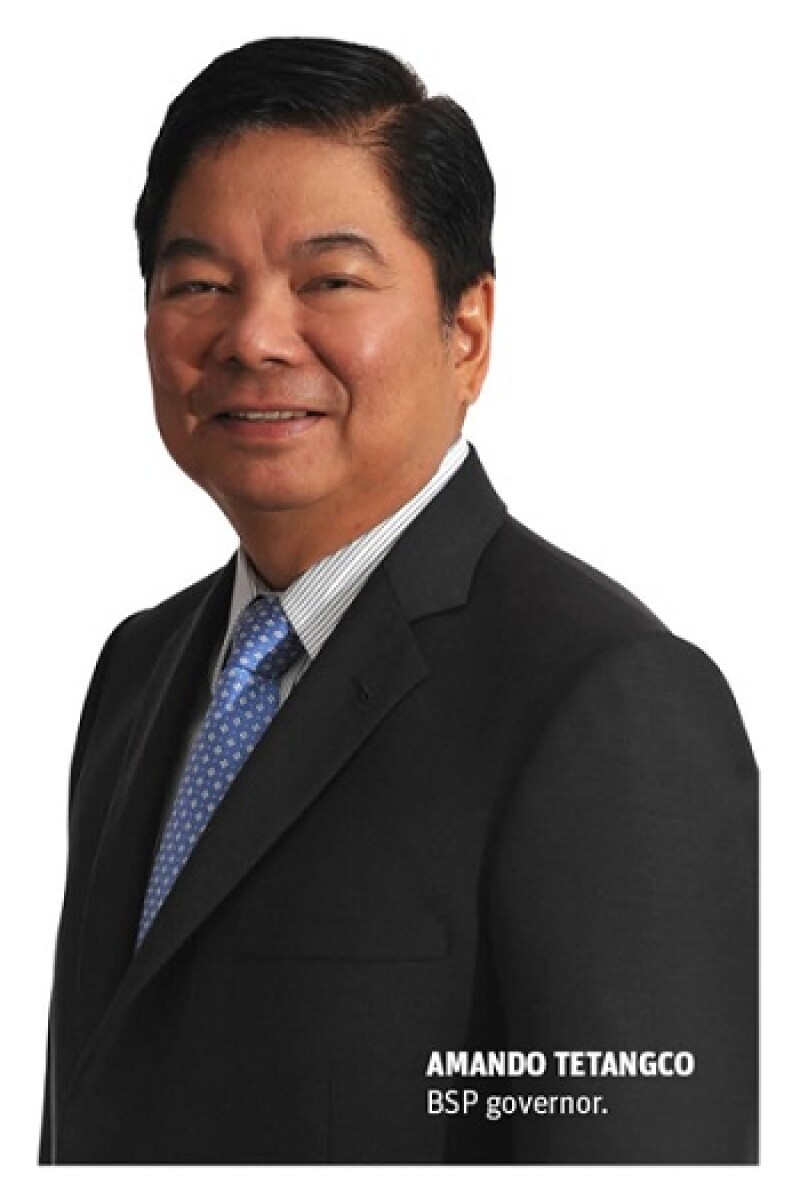
The GFC essentially plucked central bankers out of relative anonymity and put them at the front and centre of financial stabilisation and global recovery. Some have even characterised central bankers as the “national and global firemen”, tasked to put out and turn around the effect of the GFC.
Central bankers have had to go beyond their traditional role of lenders of last resort to providers of walls of liquidity to support the global economy. They have also had to learn to include financial stability in their mandate.
There are many specific ways central banking and the role of central bank governors have changed over time, but let me highlight three — focus, tools and regional co-operation.
Central banks must now look beyond inflation or economic growth and consider more closely the role that financial institutions play in transmitting monetary policy to the real economy. They also need to look beyond the safety of individual institutions. They need to determine the interconnectedness of financial institutions and how this feeds into the safety of the financial system as a whole.
Central banks have expanded their toolkit beyond policy interest rates and monetary aggregate targets. Some of the new tools include macroprudential measures, the expansion of the central bank balance sheet and extensive use of foreign exchange reserves management.
Finally, as financial markets and trade have become more integrated and the issues we face more common across jurisdictions, central banks need to offer a more co-ordinated approach to resolution.
AM: How independent is your central bank from the government?
Tetangco, BSP: The BSP enjoys independence as enshrined in the Philippine constitution and specified in the BSP Charter. While it is a government-owned corporation, it enjoys fiscal and administrative autonomy in the discharge of its mandated functions concerning money, banking and credit.
While we enjoy fiscal autonomy, the BSP participates in the national government’s macroeconomic planning process.
AM: What should be the Philippines’ key economic and monetary targets and how can the central bank best help achieve them?
Tetangco, BSP: Sustained, accelerating and broad-based growth in an environment of low and stable prices are key goals of the country. The Philippines has experienced 60 consecutive quarters of positive economic growth, with the last eight consecutive being growth rates of greater than 6%. We have been able to keep the inflation rate within target for the last five consecutive years.
We need to ensure these gains are sustained, build upon them and institutionalise the economic reforms that have enabled us to achieve them. The BSP can help by crafting policies to ensure a stable macroeconomic environment where domestic businesses can make longer-term plans for expansion which attract long-term foreign investments, and also a banking regulatory environment that provides broad access to financial services, at prices commensurate to risks to be taken.
Near-term goals of the government include an inflation target for 2014 of 4%, plus or minus 1%, while our medium-term inflation target for 2015-2016 is 3%, plus or minus 1%. There is a real GDP growth target of 6.5%-7.5% for 2014 and 7%-8% for 2015.
AM: Will there ever be an equivalent to the euro in Asia?
Tetangco, BSP: There are potential benefits to the establishment of a monetary union similar to the euro. These include the elimination of transaction costs by reducing and simplifying exchanges of goods and services across member countries.
However, an Asia-wide single currency system would likely to face a number of issues. The heterogeneous economic and political structures across the region may pose a major obstacle to the establishment of a unified regional monetary authority. In addition, issues may also arise as to the composition and weights makes up a single currency.
Nonetheless, critical progress has been made toward increased economic and financial integration, such as through the Asean (Association of Southeast Asian Nations) Economic Community (AEC). Under the AEC Blueprint, Asean seeks to achieve a regional financial system that is characterised by more liberalised capital account regimes and inter-linked capital markets. This could lay down the foundations for a common currency in the region, although one is not likely to emerge in the near future.
AM: What is your biggest challenge for the coming 12 months?
Tetangco, BSP: One challenge is sustaining the country’s favourable economic performance and achieving the government’s macroeconomic targets, over the next 12 months and into the medium term.
The balance of risks to inflation remains tilted to the upside, given the pending petitions for adjustments in utility rates. There is also uncertainty over the extent of supply-side pressures that could exert upward pressures on food prices. We also remain mindful that strong liquidity growth and rapid credit expansion in the country offer potential risks to financial stability.
With the ongoing rebalancing of growth across the globe, and the expected normalisation of monetary policy here and overseas, it will take much vigilance on the BSP’s part to help sustain the economy’s momentum. Over the next couple of years the gradual exit of central banks in advanced economies from an accommodative monetary policy stance could generate volatility in the domestic financial market.
Expectations of a tighter monetary policy stance overseas have already prompted some rebalancing of investors’ portfolios, resulting in the repricing of risks, some capital outflows, and increased volatility in the exchange rate and in asset prices. The challenge lies in minimising these undue volatilities and preventing the build-up of financial market imbalances.
AM: What would you consider to be your key achievement to date as governor?
Tetangco, BSP: I tend to measure success mainly in terms of the performance of the BSP itself as an institution. The Philippine economy continues to ride a wave of renewed momentum and dynamism, and I believe the BSP has helped keep the economy on an even keel through prudent monetary policy and sound financial supervision.
Working alongside the economic managers, the BSP has promoted a favourable macroeconomic environment that features a positive confluence of on-target inflation and stronger output growth. We have also worked hard to build up the BSP's credibility in keeping inflation stable and containing risks to the financial sector.
The BSP has also achieved significant headway in its campaign for greater financial inclusion, an advocacy that I hold close to my heart. The BSP launched in 2010 the Economic and Financial Learning Programme, which brings together the various awareness and learning campaigns of our units and departments nationwide under one flagship programme for financial education.
The BSP has been steadfast in providing an enabling policy and regulatory environment for microfinance and financial inclusion. This regulatory environment has allowed banks to serve low income entrepreneurs — which used to be seen as a high-risk, unbankable market — with a variety of services ranging from microenterprise loans, micro-agri loans, housing microfinance loans, microdeposits, and microinsurance.
The regulatory environment has also provided flexibility for banks to be at the forefront of innovation. Products and delivery channels that leverage technology and mobile applications are now being used to provide electronic money products and related financial services to traditionally excluded sectors at lower costs.
As of end-September 2013, there are now 183 banks with microfinance operations reaching over 1m clients and an outstanding loan portfolio of Ps8.08bn ($181m). This data is significant since the banking sector had no microfinance portfolio prior to the year 2000.
In 2014, we plan to step up our advocacy for greater inclusiveness, especially amid the need to rebuild and rehabilitate in the areas most affected by recent natural disasters.
AM: What goal would you like to achieve before the end of your time as governor?
Tetangco, BSP: Our vision at the BSP is to see a more progressive Philippines. We hope that we reap as well as continue to build on the gains our economy has attained through our investment in purposeful reform and sound policies today.
We hope to strengthen further the framework for conducting monetary policy through the fine-tuning of the various instruments in our toolkit. In particular, preparations are underway for a possible shift to an interest rate corridor system, which would help promote a closer congruence between the monetary policy stance and market interest rates.
We hope to gain more headway in pushing for various adjustments to our charter, which has not been amended since taking effect in July 1993. These amendments will enable the BSP to respond adequately and reliably to the evolving needs of the expanding economy as well as to the increasing complexity and sophistication of the financial system.
I would also like to help strengthen the base from which the BSP as an institution would thrive. I am now building human capacity in the BSP, both in technical aspects, including economic model-building and banking risk-based supervision, and the softer skills of leadership and resource management.
I inherited a well-functioning and independent central bank in 2005. I would like to bequeath an organisation that is even stronger, more focused, nimbler and better able to efficiently deliver on its more complex mandate. AM