
Asiamoney (AM): How has the role of the BoT and its governors changed during the last 25 years?
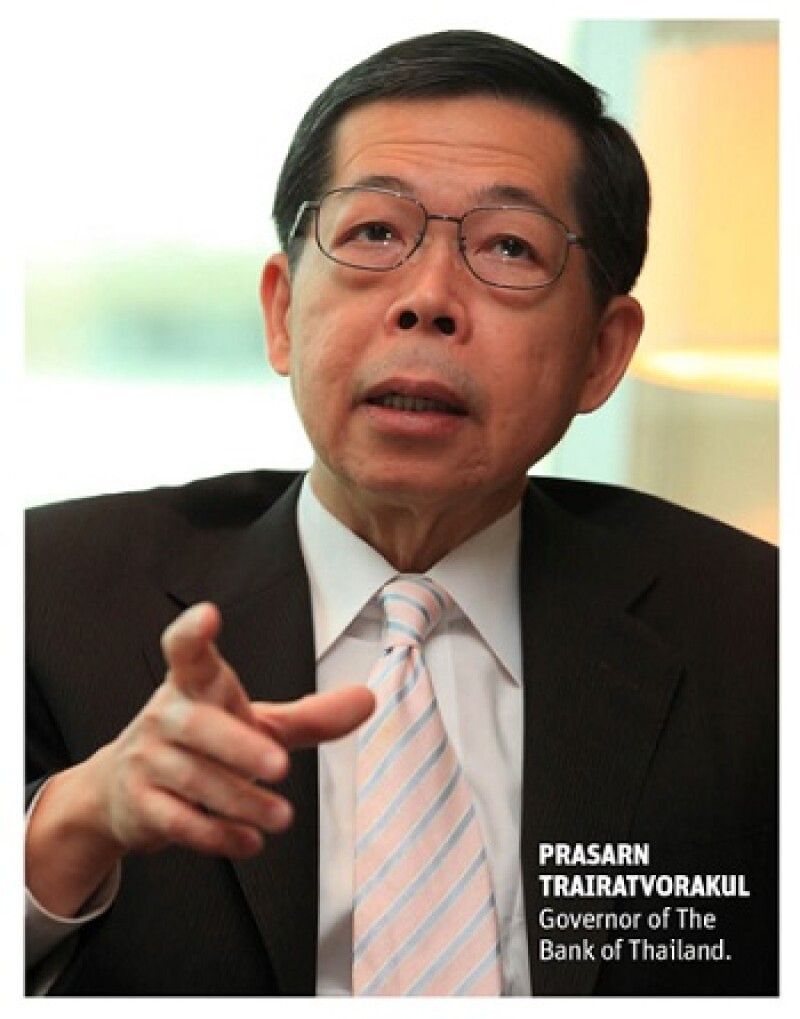
Prasarn Trairatvorakul, BoT: The economy has changed, the challenges have changed — they are more complicated than in the past. The central bank’s role has been expanded. Policy tools are more diverse. In the old days we were perhaps more confined to the goal of monetary stability but now we have the task of maintaining financial stability, which is more encompassing.
Staff numbers have grown proportionately. We have to look at an expanded scope of what’s going on, whether it is real estate or what’s happening in the stock market or in levels of household debt. In the old days, the banking sector was the dominant issue, but now there are investment products, mutual funds, derivatives, structured products and so on.
This is the macroeconomic side, but there are other aspects, like foreign exchange policy. In the old days, you could live with the fixed exchange rate and gold standard regime but these days, with the major economies having very flexible monetary policies, it can go in all kinds of directions. It’s a variable now, not just a fixed factor to be taken for granted.
AM: How independent is the BoT from the government?
Trairatvorakul, BoT: The word independence has different meanings for different people. But a practical answer for you is that we have what we call "full legal operational independence" on the conduct of monetary policy.
Under the inflation targeting framework, the procedure is this. We submit the following year’s inflation target to the finance minister, we talk with him, we negotiate with him and if agreement is reached and he presents that target to the cabinet, the cabinet has the final approval authority on that target.
Once the target is approved, we are separate. We have, I think, quite a degree of independence to choose the timing and tools in order to achieve that target.
The monetary policy committee (MPC) comprises the governor as chair, two deputy governors and four outside members who could be from anywhere — the private sector, academia — but they should fit certain criteria, such as having no conflicts of interest. It’s an outsider majority but it’s also a balance of three [BoT] insiders and four outside. And sometimes the BoT deputies vote differently from the governor.
There have been cases when there have been calls from the political circle for us to lower the rate but we did not do so. A case in point was last year. In the first part we experienced huge inflows of capital, because the Thai economy was attractive to international investors. The baht strengthened and we had to come up with a mixture of policy tools and proper timing to decide on the rate and the FX as well. And we did it in such a way [that was] quite independent from the preference of the politicians at the time.
AM: How does today’s level of independence compare to 25 years ago?
Trairatvorakul, BoT: Much better. When I was a much more junior officer here, from 1983, there was only a single person with any authority – the governor – and the framework was not as transparent as now. The central bank did not have to explain much to the public. On the other hand, the governor could run into conflicts with the Minister of Finance very easily and the minister could change the governor at any time.
We report to the finance minister, but I am the first governor under the structure introduced by the 2008 Royal Reform, whereby the governor comes into office with a fixed term of five years. We have operational independence. Now we tell the market when we are going to meet and how any times in a year. Every time the committee meets, we have to prepare reports a week in advance and then the individual members have to cast votes in a transparent way. After the meeting we have to hold a press conference, and we disclose the voting results. After three weeks, we have to disclose the minutes.
AM: Do you think Asia or Asean (Association of Southeast Asian Nations) will ever have the equivalent of a euro for the region?
Trairatvorakul, BoT: Not in the foreseeable future. If you use a single currency you have discarded monetary policy, which is quite important for your economic development. Political integration in Asia is almost impossible — it's too diverse. I also don’t think a free flow of labour can happen easily in this region. It’s easier in Europe.
But if you want my guess, I think there will come to be a dominant currency. Many economies in Asia integrate more into the international supply chain now, like Japan, China, and Asean. Look at Thailand and Japan, for example — lots of automobiles, electronics and so on are located here. Two years ago, we had a big flood and the price of notebook computers in the world market increased because we are a major producer of hard-disk drives. Our flood affected the automobile industry of Japan and their earthquake impacted here.
Being in the supply chain, unavoidably, the currency or exchange rate will have to be aligned some way or the other. You want to keep the competitiveness of the economy unaffected by the exchange rate so I would imagine the result will be the emergence of some dominant currencies. It could be the renminbi or the yen — these two are the most realistic. Then other currencies would reference it.
AM: What is your biggest challenge in the next 12 months?
Trairatvorakul, BoT: To fulfil the basic goals we have. Certainly we want the economy here to grow to its full potential. Second, we want such growth to be sustainable. Thirdly, we want it to be well distributed.
Some years back, we would often tell people that 5% annual GDP (gross domestic product) growth would be a good potential, but lately that 5% can only be achieved with good investment to sustain competitiveness. With the current political unrest we certainly have some concerns over whether we can bring healthy investment.
AM: Have you changed your policies because of the political unrest?
Trairatvorakul, BoT: Yes, but there are drags on domestic demand — you have observed a good part of it [it took Asiamoney two hours to travel 5 kilometres across Bangkok by taxi to the BoT office, because of delays caused by political protests]. Some hotels have occupancy rates of only 10%.
We have done what is possible within our mandate: last week [on March 12] we cut the [benchmark] rate [by 25 basis points] to send a signal that we were helping a bit when the rate was already quite accommodating. The major credit agencies have re-confirmed the country's credit standing and that helps for investor confidence. We want to do things in such a way that the market has confidence.
AM: What goal would you like to achieve by the end of your term?
Trairatvorakul, BoT: When I came into office, I had some things in mind that were important. The fundamental one was to maintain the economic stability of the country, and I think “so far, so good”. I think we’ve been able to restore confidence and the exchange rate has been, so far, quite resilient. The banking system is also quite resilient.
Second, I always tell my staff that I want this organisation to have people with good strategic direction. I want to end my term with people looking at the BoT as an organisation with clear thinking, and I have introduced quite a number of management tools here.
The third area is the development of human capital, adhering to good principles of integrity, good vision, practicality and being willing to collaborate and be flexible. This is a 71 year-old organisation and it has been quite strong on the first two but has lots of room for improvement on the latter two.
AM: Is there a standout moment in your term so far?
Trairatvorakul, BoT: We have certainly gone through quite serious challenges from politicians and so on over these past three years. I think so far we have been able to show we still retain our integrity and do not just sway with the political powers.
But I don’t want people to misunderstand that we are isolated ivory towers. We always participate; we give our thoughts, our views in many forums. We never retreat — in fact we proactively explain what is good for the country. Even in the meeting of economic ministers headed by the prime minister, I’ve said frankly a number of times that there is spending by government which can be classified as good and bad.
I felt I could talk with a clear conscience because there were no political [factors]. And I told them in a proper forum, in a closed door meeting, a meeting of the economic ministers. But you will observe that I have refrained from going out in public in the last few months so as not to be seen to favour one side over the other. I think it's not fair at the moment, at a time when they are competing against one another.
AM: There has been political activism within Thai ministries and state institutions. Has that happened here amongst your 3,000 staff?
Trairatvorakul, BoT: I said clearly to my colleagues that each individual can have their own point of view but you have to act after office hours. You can go there [to the demonstrations], you can participate if you want to, but try to avoid saying you represent this organisation.
I explained the reasons — there are bigger responsibilities, we want to execute certain things that are good for the country, and what you do can hinder that opportunity. AM