
Asiamoney (AM): How has the role of Bank Indonesia changed over the past 25 years?
Agus Martowardojo, Bank Indonesia (BI): Only since the Asia financial crisis has it become an independent, credible central bank.
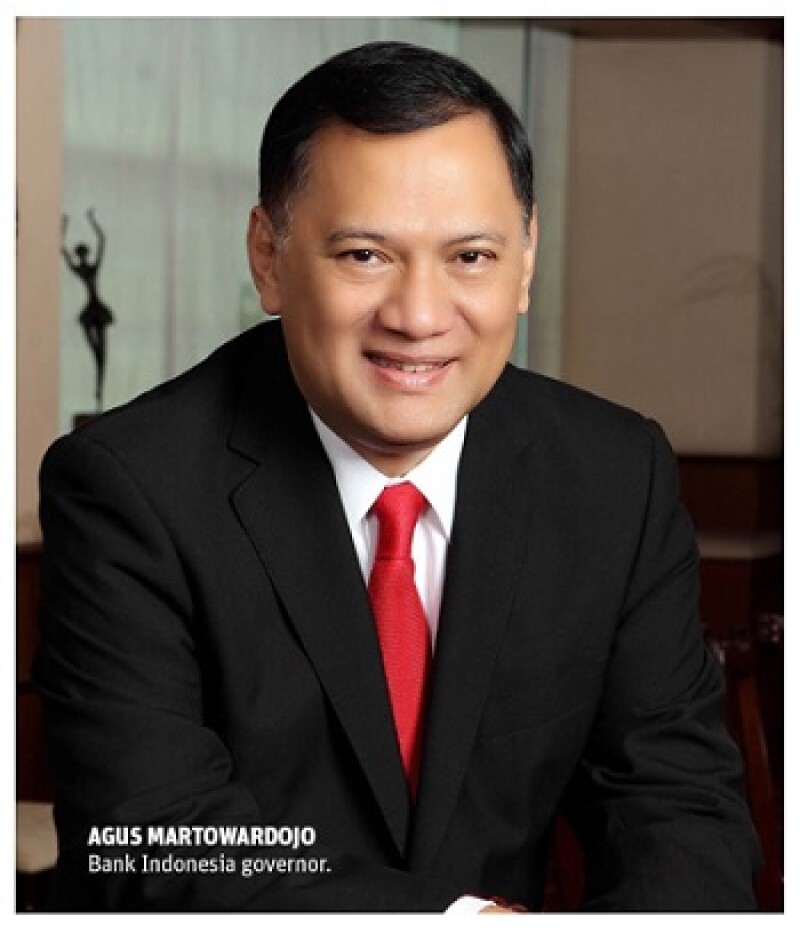
Before 1999 it was part of the government, and had to execute many policies on behalf of it, such as providing funds to special programmes. When we tried to manage and supervise the commercial banks we were interfered with by the government. We were not independent enough to supervise wrongdoing or prudential issues.
After the crisis one law was put into place making us independent, while another law stated that we needed to separate commercial banking supervision. For 11 years we failed to finalise [the latter], but in 2011 the government created a new law creating the OJK, or Indonesia's financial services authority, when I was minister of finance. We successfully implemented it in 2013 when we migrated banking supervision from the central bank to that body, after I had moved here as governor.
AM: How independent is Bank Indonesia from the government?
Martowardojo, BI: The Bank Indonesia law passed in 1999 clearly states this is an independent institution that is not part of the government. Of course while we are independent we will coordinate with them.
Last year for example we had the risk of financial instability, the [US Federal Reserve] intended to start tapering and we also had a current account deficit and the risk of inflation. We communicated with the government but decided ourselves that we had to adjust the policy rate. We believe it to be a preemptive and bold decision to get ahead of the problem.
It's very important for Bank Indonesia to ensure financial system stability in addition to controlling inflation. If there is a crisis from outside or inside Indonesia, it usually takes the form of a shortage in liquidity, or exchange rate volatility, or inflation, or a banking collapse. The central bank has to be in the front line responding to those areas and it's important that it is independent to do so.
AM: What should be the key economic and monetary targets of Indonesia for the coming years?
Martowardojo, BI: Our inflation last year was 8.3%, largely because the government had to reduce fuel subsidies. For 2014 I am targeting 4.5% plus or minus 1%, and in 2015 4% plus or minus 1%. Those are the main targets. Meanwhile we want an efficient exchange rate that really reflects the fundamental economy of Indonesia.
One of our challenges as a country is that we need to improve our supply side if we were to grow beyond 6% [per year in gross domestic product terms]. Every time we grow over 6% the country's supply side isn't ready to fulfill the demand, so imports rise and that hurts the current account. So our message to the government is: please continue with your structural reform.
I'm currently finalising an enhanced strategic plan 2014-2024 and as part of this we have engaged a management consultancy for the first time. It's a commitment to change, inviting outsiders to support our programme and finalise our strategic plan. The kickoff of the plan was yesterday (April 24); we invited all members of the board, all general managers to commit to the change. I'm sure in six months we can finalise the plan.
AM: What can the central bank do to encourage foreign investment and capital inflows into Indonesia?
Martowardojo, BI: When I joined the central bank I was surprised by how shallow the FX market was. In May and June 2013 our daily FX interbank volumes were between $300m-$500m a day. And Pertamina, the state owned enterprise responsible for oil and gas, bought $300m-$350m [of US dollar denominated products] a day alone. So when there was a pressure for capital outflow the central bank had to supply US dollars, which was not healthy.
I have been and continue to place an emphasis and priority on FX deepening initiatives. The first challenge was the exchange rate itself. In Indonesia there were times when we had a dual rate, where the rate on Reuters for example would not reflect the market. It took me three months from June to September to focus on that, and now we have an efficient price that is convergent and reflects the market. Now exporters are more prepared to bring revenue back, instead of holding [dollars] on the sidelines.
Having an open market requires efficient systems and transparency. We have conducted several financial deepening initiatives to do this, including introducing a swap facility and a long term swap facility, plus Bank Indonesia time deposits for foreign exchange.
Now daily [interbank FX volumes] are $1.8bn-$2bn; it's still low but much better. Indonesia is almost a $1tr economy; daily FX volumes should be $10bn-$15bn – it's $14bn-$15bn in Malaysia each day and we are a much larger economy.
We formed the Indonesia foreign exchange market committee, which includes representatives from commercial banks, the central bank and the OJK, to explore the initiatives to deepen the market. They have prioritised finalising a proper code of conduct to underpin efficient financial markets, and I am supporting that. And I continue to invite commercial bankers, especially treasurers, communicate that we will no longer have a multiple rate and share with them our reforms.
AM: What is your key achievement to date as governor?
Martowardojo, BI: I started on May 24, two days after the [US Federal Reserve] announced plans to begin tapering its quantitative easing. So over the first half year I had to focus on managing inflation and stabilising the currency.
I surprised many people with my response, which was to increase the policy rate every month until it rose in total by 175 basis points. I combined this with several other instruments and policies, including the exchange rate policy, whereby I allowed the exchange rate to really adjust according to the fundamentals. As a result it depreciated by up to 26%. Plus we issued our macroprudential policies, adjusting the [banks'] loan reserve requirement as it related to liquidity.
Indonesia's second quarter current account deficit had been 4.4% over GDP in the second quarter of 2013, but after we responded it dropped to 1.98% in the last quarter, which really gave confidence to the market.
I'm particularly pleased that the central bank agreed with the government that we had to focus on stabilisation over growth. When the government increased the fuel price it created pressure on inflation, which rose from 4.3% to 8.3% last year. But when we previously lowered our fuel price subsidies in 2005 and 2008 inflation afterwards rose to 17% and 11% [respectively]. So 8% was a good result, which was possible because the government and BI coordinated our responses.
I'm also pleased I migrated the OJK banking supervision with over 1,200 people to the FSA. Migrating a core function of an institution for 60 years is a challenge as it creates moral problems too with the staff. We motivated them and encouraged them before moving them, and it went smoothly.
AM: What has been your biggest disappointment?
Martowardojo, BI: Discovering how thin and shallow Indonesia's foreign exchange market was. That hurts me, so [improving it] is one of my priorities. Every week I ask a team to report on the FX market at a meeting of the [Bank Indonesia] board. If corporations or institutional investors have a demand for FX and we only have a shallow market it creates instability. And it risks limiting institutional flows.
When I joined, Indonesia's credit default swap was 220 basis points, which was a concern. But I realised one important aspect that caused [this spread] was the liquidity and convertibility of the exchange rate. There were times when investors wanted to invest but when they wanted to check out, they could but couldn't exit, due to the foreign currency restrictions.
It's a matter of integrity to let them know that we welcome their investment and they can leave if they wish. I had to go especially to the US to convince the fund managers that we were addressing this issue, that there would be no dual or triple rate [of rupiah valuation], that price discovery will be efficient, and that liquidity and convertibility will improve.
There are plenty more reforms we can conduct. I need to relax many regulations and review instruments. Many were grounded in 2005, but I don't think simple options and forward contracts and simple swaps and simple structured products should be, so I need to reintroduce them.
AM: What goal would you like to achieve before the end of your time as governor?
Martowardojo, BI: In brief, I want to deepen the financial markets, maintain financial stability and ensure inflation remains under control. Plus I want to ensure we have a stable and secure and effective payments system, and we contribute to financial systems stability.
One other point is to ensure our financial inclusion initiatives are effective. We have 250m people but so many are unbanked. It's our responsibility to expand the financial services system to encompass more people in the real economy and grow small and medium enterprises.
I also want to improve the mindset of the people in Bank Indonesia. We have to admit that some colleagues and former governors have legal cases against them, and I want to instill commitment and human values into all the team. I love my team here and I think the human capital in Bank Indonesia is one of the best in the country. I want to get commitment from all of the Bank Indonesian people, to give them the belief that we will have a credible central bank.