When it comes to capital-raising, timing is everything. And now is the time of commodities.
Prices of metals and fossil fuels are booming due to a weak US dollar, inflation concerns, continuing turmoil in the Middle East, and the raw demand of fast-expanding countries like China.
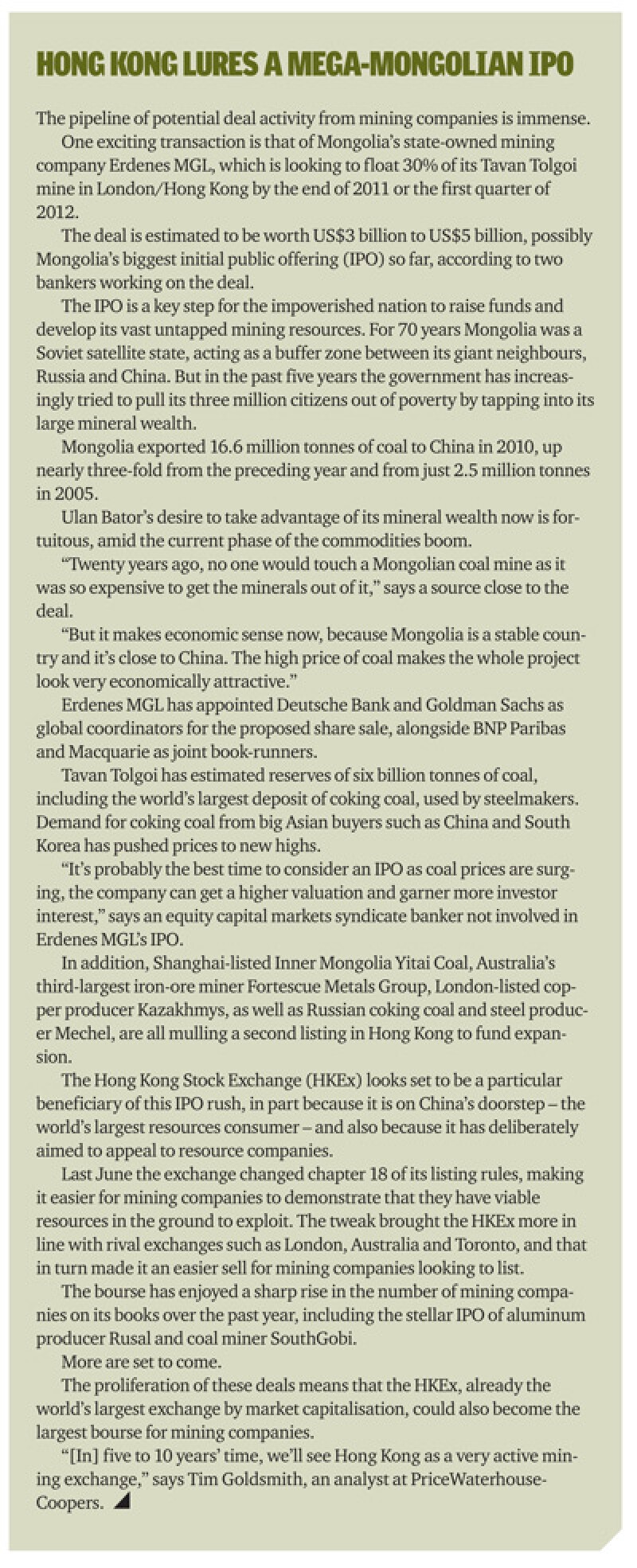
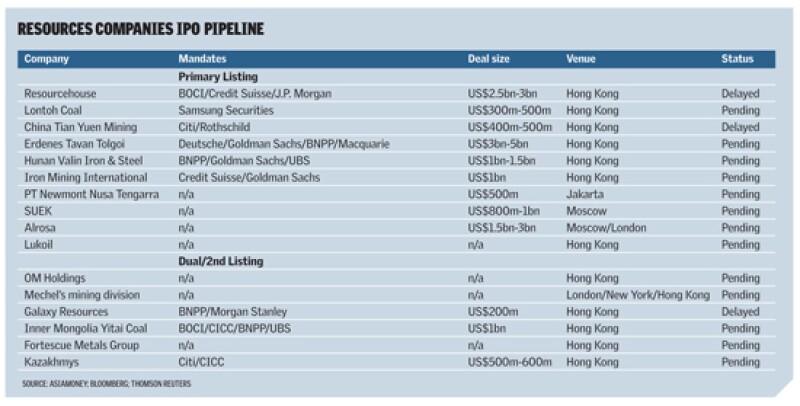
Many producers are eager to take advantage of this investor euphoria to raise money, especially in the equity markets (see box on page 30). Mongolia’s state-owned mining company Erdenes MGL, Australia’s Resourcehouse and Russia’s Alrosa are just a few commodity firms planning to sell shares.
But by far the most high profile is Glencore. The world’s leading commodities trader is eyeing the biggest global initial public offering (IPO) of the year so far. It was set to dual-list a US$12 billion IPO in London and Hong Kong, with pricing guidance expected on May 4, as Asiamoney was going to press. Its shares are then set to begin trading in London on May 18, followed by Hong Kong the next day.
If successful, the dual listing would value the firm at more than US$60 billion. Such ambition points to the level of investor faith in the world’s commodity industries.
“The high price of resources is something that drives investor appetite. The fact that the current spot prices are holding up particularly well means that you continue to see good value within these stocks,” says John Lydon, managing director and co-head of equity capital markets, Asia at Deutsche Bank.
It’s easy to see what he means. Crude oil prices have risen in recent weeks to two-and-a-half year highs, with US crude oil futures hovering above US$110 per barrel while North Sea benchmark Brent crude oil surpasses US$125.
The spot price of gold, meanwhile, hit a lifetime high of US$1,538 an ounce on April 28; and some observers feel it will go above US$1,700 soon. Silver reached a 31-year high of nearly US$50 an ounce on April 25.
Aluminum has also advanced to US$2,740 a tonne, climbing an average of $75/tonne per month since a June 2010 low of just US$1,858/tonne, fuelled by steady demand from China.
But the danger is that the prices of these resources have been rising too far and too fast. Fears are rising that a near-term correction could be on the cards – and that Glencore’s coming listing is because it believes that the market has peaked.
While a correction in commodities prices might pose a good entry opportunity for commodities investors, it would be damaging for equity investors that buy into these upcoming IPOs. Is Glencore the herald of a major commodities correction?
Timing concerns
Founded in 1974, the Switzerland-headquartered Glencore has been mulling an IPO for years. Yet it is only now, following a sustained bull run in commodity valuations, that the company has opted to proceed.
Glencore is essentially a trading house. It has a lot more in common with an investment bank or a private-equity firm than with a mining conglomerate, with a global footprint and intelligence across nearly all important commodities markets.
The company has grown rapidly since management bought out controversial former tax fugitive Marc Rich for US$600 million in 1994.
It now dominates physical trading in metals, oil products and agricultural products, as well as engaging in mining, sourcing, logistics, financing and storage of metals and minerals, energy products and agricultural products.
In the past year, Glencore’s revenue soared to US$145 billion from $106.4 billion, while profit rose 39% to US$3.8 billion.
The company also enjoys a reputation for having a sharp sense of timing and profound trading expertise. Investors, therefore, have good reason to be wary at its decision to begin offloading shares now.
A company would be unlikely to do so if it believed that a great deal more upside was likely for commodity valuations in the short- to medium-term.
“[Glencore] is run by very smart, very seasoned traders,” says a London-based asset manager.
“The one thing that traders are supposed to be good at is timing the market, it’s probably the right moment to sell shares, but I doubt if this is a good time to buy them.”
The past decade has revealed that when major trading businesses come to market, it indicates that a market peak is imminent, with a drop to come soon after. Parallels are being drawn with Wall Street bank Goldman Sachs deciding to float in 1999, near the top of the dotcom bubble.
No one questions Goldman Sachs being a great investment bank. But you would have lost money if you bought shares in its IPO in May 1999 and sold in November 2008, during the global financial crisis.
The IPO of the renowned Blackstone Group is another painful example. The world’s largest private-equity firm went public in 2007 with an IPO price tag of US$31 per share. At first its stock did well, reaching US$35 on its first day of trading. But within a year, the private-equity industry collapsed and so did Blackstone’s stock price. The shares once sank to US$4 and now still trade at below US$20.
The fear is that the commodities market could be set for a similar situation, and that this time buyers of Glencore stock will be the ones to rue their investment decision.
Equity for acquisitions
Of course, toppy markets make it the perfect time for resources companies to raise money via equity issues.
The rise in commodity prices has bolstered their bottom lines and made them look appealing. By selling equity now rather than a year or two ago, the companies can most likely gain much higher valuations, and therefore make more money. It’s an appealing proposition for expansion-orientated companies.
“Imagine the resources you are holding on to are worth much more than they used to [be], and of course you’re going to sell them at a higher price,” says Linus Yip, chief strategist at First Shanghai Securities in Hong Kong.
“To raise money at the peak of a cycle or at what looks like a peak in a cycle, build your war chest for acquisitions and you may even use the stocks as an option to pay for your bids. It’s a very smart thing to do,” he adds.
Glencore is one such cerebral business on the hunt for acquisitions and has been accumulating positions in mining companies. It already has an 8.8% stake in UC Rusal, the world’s top aluminum producer, and a majority position in Minara Resources, a nickel producer.
However its biggest asset is a 34% stake in London-listed Xstrata, worth more than US$24 billion now. It is widely expected that Glencore will make a bid for the world’s fourth biggest copper miner once it completes its proposed listing.
Were Glencore to take over Xstrata, it would become a commodities powerhouse on par with firms such as BHP Billiton and Rio Tinto.
In fact, a controlling stake in Xstrata holds the key as to how equity analysts or asset managers value the company.
“It gives us at least something to base on, as the 34% stake [in Xstrata] has a clear market value,” a Hong Kong-based institutional investor tells Asiamoney. “Its business is complex. Glencore is a trader, but it also has some mining operations and investments in other resource plays.”
Various investment banks use a range of measures to value Glencore. Some use a sum-of-the-parts model, which adds up the values of different bits and pieces the company owns. Others use price-earnings (PE) ratios.
Credit Suisse and Barclays so far have valued the company at US$53 billion to US$69 billion, about 13-18 times its 2010 earnings. This compares to Rio Tinto, which has a price-to-earnings ratio of about 10 times. At the very least, Glencore looks fairly valued by its IPO.
The cost of M&A
While raising equity capital now makes a lot of sense for resources companies, using the capital to conduct M&A can be costly for the very same reasons – resources companies are becoming expensive.
Barrick Gold Corp., the world’s biggest gold company, agreed on April 25 to buy copper producer Equinox Minerals for C$7.32 billion (US$7.66 billion) in cash, trumping a hostile offer from China’s Minmetals Resources.
Barrick’s offer values Equinox at more than 14 times its 2010 earnings before interest, tax, depreciation and amortisation (Ebitda) of US$523 million, a level far too rich for many analysts’ palates.
The takeover will give Barrick Gold exposure to base metals, but it is also going to cut its earnings multiple. While gold miners on average trade at more than 10 times price-to-future cashflow per share, base metals miners trade at six to seven times. Barrick’s shares have sunk almost 10% since it announced the deal.
Making an acquisition at the peak of a commodity cycle means those investing in the acquiring unit may simply overpay.
“Acquisitions could come at top prices because almost all assets were inflated,” says Steven Leung, a sales director at UOB Kay Hian in Hong Kong.
And commodity prices can have big swings.
“We should also take into account the production costs and the time gap. After you pay a high price and start working on mining projects, commodity prices may fall by the time you finish [the projects],” Leung adds.
Nearing the top?
The sensible thing for commodities companies to do is raise money when the market is nearing a peak, and then hold on to it until the peak passes and the valuations of both resources and the companies distributing them fall.
Signs are emerging that the drop may be near. Goldman Sachs, with a commodity trading expertise that rivals Glencore, recently advised investors to take profits on several commodities, such as copper, cotton, crude oil and soybeans, reversing its buy recommendation from last year.
The bank remains confident about commodities in the long run, but says short-term price pressure is stacking up.
Commerzbank also points out that commodity prices may correct in the next three to six months, although the German bank believes that long-term prospects remain good due to supply constraints.
There is one obvious reason for a price correction: these commodities rallies have already taken a toll on many economies, feeding inflation and hurting growth rates.
The rise of oil prices in particular can have painful economic effects. As Thai finance minister Korn Chatikavanij told Asiamoney in our April edition, the rise in fuel price is his key economic concern for Thailand, a major importer. He is not alone.
But as the impact of commodities hikes are felt, demand will wane as speculators lose appetite. That will cause a market correction.
“A number of industries and countries is already struggling under the weight of high oil prices. To begin with, we see some impact on the airline sector, the shipping sector, and we have also noticed that the spike in oil prices is translating into weaker retail sales,” Francisco Blanch writes in a recent Bank of America-Merrill Lynch research note.
The US bank predicts that the Brent crude oil price will fall back to US$94 per barrel in the fourth quarter, roughly a 25% correction from the current level.
Additionally some factors that have supported rising commodity prices might also fade, exacerbating a downturn.
“The commodity rally is pretty much supported by a weak dollar. If the US central bank decides to increase interest rates later this year, the rally could reverse,” Carsten Fritsch, a commodity analyst at Commerzbank in Frankfurt, tells Asiamoney.
“Despite the [fact that] long-term demand from China remains strong, the country is trying to contain its stubbornly high inflation, which means its short-term demand might falter,” he adds.
Buyer beware
A commodity market correction might be good news for commodity investors and would certainly provide a better entry point.
But it would not be good for equity investors buying into resource-company equity offerings right now. Dropping commodity prices would cause an equivalent fall in the valuation of the companies that produce and trade them.
If markets do correct, buy-and-hold investors could well find themselves in the red over bull-market investments.
Those considering putting money into resources and mining IPOs should heed this advice: the best time to buy will be once the hype has subsided. And that includes the shares of Glencore.
After all, timing is just as important for investors as for acquisition-minded commodity traders.