
If the summer storms in the world’s currency markets have done anything, it is to have reinforced the danger of foreign exchange (FX) risk.
Higher-beta G10 and emerging market currencies have all experienced sizeable drops over the past few months, particularly those of commodity-exporting countries. The bout of volatility was prompted by indications from the US Federal Reserve (Fed) that it could soon begin to taper its quantitative easing (QE) programme.
The uncertainty led to a flight of capital out of emerging markets, plus marked shifts in the currencies of countries deemed vulnerable to a stronger US dollar. Two prominent Asian currencies were particularly affected: the Indonesian rupiah and Indian rupee. The rupee touched an all-time low of INR68.8450 on August 27 while the rupiah crashed on September 3 through the IDR11,000 threshold to IDR10,050. The two were the worst-performing currencies in the world this year.
The sharp slide in both currencies reflects concerns over India and Indonesia's current account deficits, the funding of which has been complicated by a reversal of global portfolio capital. Fitch Rating warned on August 22 that the current account deficits of both could yet rise further. Rapid private sector credit growth, widening fiscal deficits or sustained higher inflation could also lead to a broader and more sustained loss of confidence among investors.
This underscores the two jurisdictions’ underlying vulnerability, which economists have collectively labelled “Indianesia”.
The impact of the drop-off has been marked. Many companies that make money in India or Indonesia but have large unhedged US dollar costs have been forced to convert more local currency to meet these offshore payments. With the US dollar having increased by 25% against the rupee between January 1 and September 1, this left corporates with unhedged US dollar costs having to fork out up to one quarter more to fund them.
The drop-off has also made a salutary impression on companies that were not directly impacted, but also possess FX exposure on their balance sheet. Bank of America-Merrill Lynch (BoA-Merrill) highlighted in a chief financial officer (CFO) outlook survey published on July 9 that 22% of Asian corporates say currency volatility is their second greatest concern, after commodity prices, which accounts for 37%.
Companies based in current account deficit nations such as India and Indonesia in particular need to consider all options to reduce their exposure to the pitching and yawing of foreign exchange markets. These include hedging and cash management options.
Anticipating currency volatility is a difficult task for any CFO and corporate treasurer. But as the damage wreaked by FX volatility on some corporate balance sheets reveals, it's a problem that cannot be ignored.
Unhedged hurting
The most traditional way for companies to shield themselves against marked currency movements is hedging.
Companies do this by using derivatives to lock in a proportion of their total foreign currency-denominated costs or debts at a set value against their home currency. It costs money, and can be very expensive when market volatility abounds, but it reduces the pain of sudden foreign currency appreciations.
The dangers of not doing so are being experienced by companies in India and Indonesia. Corporates in the former in particular have raised a lot of unhedged foreign currency debt over the past five years.
The subsequent decline of the rupee has inflated their total debt levels, the cost of interest payments and refinancing costs in rupee terms.
“Indian corporates have borrowed heavily from offshore markets to take advantage of lower rates,” says Priyanka Kishore, India analyst at Standard Chartered. “The big issue is that a substantial part of these borrowings are unhedged. The SMEs [small-to-medium-sized enterprises] would be most hit by these because they cannot unwind their unhedged exposures.”
Additionally, the authorities in India and Indonesia have imposed higher interest rates in order to retain capital outflows. It's left companies with higher funding costs all-round.
Bank Indonesia (BI) is caught between the risk of a depreciating currency and the risk of slowing gross domestic product (GDP) growth. It has responded by hiking rates up by 100bp in the past four months.
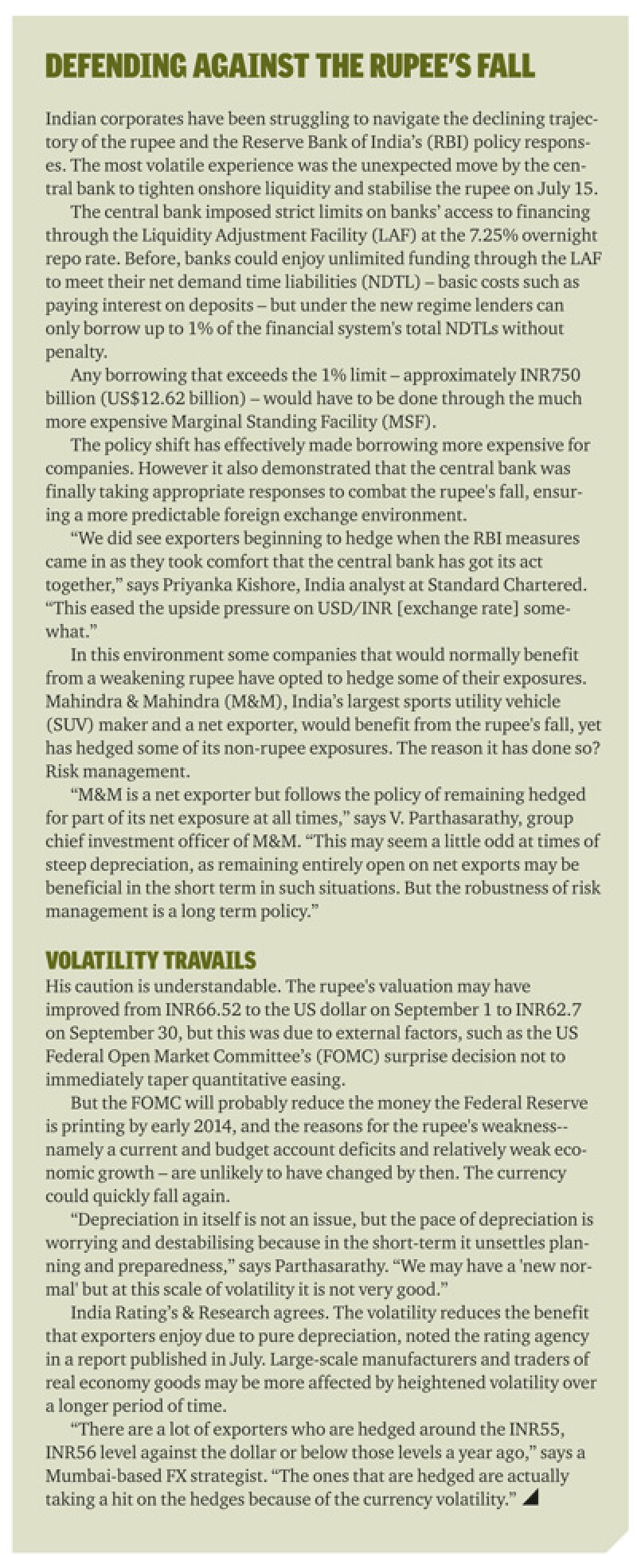
Meanwhile, the RBI pushed up the rate at which it lends money to banks by 200bp to 10.25%. The marginal standing facility, which is the rate at which banks borrow additional funds from the RBI, will now be 10.25%.
“Some have decided to revert back into local currency funding and are not depending on US dollars for their funding anymore because of the volatility,” says Andrew Ong, head of liquidity and investments at Bank of America-Merrill Lynch. “It’s also not helping that the rates of the local currency have also moved.”

Lessons learned
The painful lessons being experienced by companies in India and Indonesia have led even conservative corporates – which strictly avoided hedging practices in the past – to become more open to ‘strategic’ hedging.
“As US yields moved higher, volatility picked up on the expectation of Fed tapering later this year and the elimination of QE next year,” says Callum Henderson, global head of FX research at Standard Chartered. “From a corporate perspective, this volatility has triggered a wave of interest in longer-term, strategic hedging of transaction risk rather than maintaining a shorter-term approach.”
Using FX hedging can be crucial in mitigating translation risk, especially in the emerging markets. Translation exposure results from when the assets and liabilities of a company's subsidiary are converted back into the parent's currency. In practice, large fluctuations between the subsidiary and parent currencies can have a big impact on the consolidated balance sheet.
From a translational risk perspective, the hedging practices embarked by corporates tend to be long-term and strategic.
Treasurers often hedge their projected cash flows denominated in a foreign currency for the entire financial year in order to minimise the impact of fluctuations on their future balance sheet, note experts. That way, the profits that are realised 12 months later are covered.
A separate form of FX risk is transactional risk, which is the exchange rate risk associated with the time delay between entering into a contract and settling it. The greater the delay, the greater the exposure to fluctuations in the exchange rate between the two currencies.
These tend to be working capital-related transactions, where the duration of the hedges put in place is no longer than 90 days, with the average of around one month, note bankers.
There are both pros and cons to hedging short term FX exposures.
“The advantage is that it is short term and they can adjust their positions accordingly,” says Ong. “When rates move in their favour they would be able to adjust 30 days later.”
“[With emerging market currencies weakening], they need to realise that every time these short-term hedges mature, there might be still a need to continue these hedges,” he adds. “There will be an unrealised loss that they will have to realise at maturity.”
What this means is that if the local currency continued to depreciate against the US dollar, a corporate with foreign borrowing requirements would need to shore up extra local currency in order to extend the hedge. This eats into the company’s funding.
Cross-currency pooling
Companies that failed to strategically hedge in time for the latest bout of FX volatility still have a few cash management strategies they can use to reduce their costs. Multi-currency notional pooling structure is one such method.
Considered one of the most advanced liquidity management solutions available to companies, the primary target of each cash pool is to optimise and use the surplus funds of all subsidiaries in a group to reduce external debt and increase liquidity.
In a notional pooling structure clients can draw down their US dollar accounts, for example, up to the equivalent amount in another currency – for example the rupee or rupiah – without having to pay the costs of any associate overdraft. In other words, corporate treasury centres can effectively leverage their internal funding across currencies, which can help them in turn benefit from FX cost reductions and increased operational efficiencies.
“Under an offset notional pool, clients can potentially save on the entire overdraft charge if there is sufficient surplus to offset that overdraft position,” says Swee Siong Lee, global head of corporate products for transaction banking at StanChart.
When pooling across multiple currencies, corporates get the flexibility to choose which currency interest is paid and there is a wide range of flexible interest apportionment services available. It's much cheaper than having to ask bankers to offer a temporary overdraft line or obtaining a bank loan for liquidity shortages beyond the duration of two to three quarters, note experts.
“It avoids the physical movement of funds and consequently can provide administrative savings,” says a Singapore-based transaction banker.
The only prerequisite to launching a multi-currency notional pooling structure is that the subsidiaries of the group have to come together to agree that they will share the credit and debit balances.
Also, the group company must be sophisticated enough to ensure it can reconcile all the information across different entities.
“This is a complex structure and not all customers have the right profile,” says the transaction banker. “A multi-currency notional pooling structure fixes one problem but also may create other accounting considerations. The company has to be sophisticated enough and have the back-end systems to actually account for all these entries.”
Despite all these issues, remaining exposed to currency volatility at this moment is not a healthy option for corporates.
In order to keep shareholders happy, both CFOs and corporate treasurers should take pre-emptive steps to curb currency movements, whether they are in their favour or not. These steps include embarking on strategic hedging policies, altering fund-raising strategies or implementing a multi-currency notional pooling structure.
The sooner the region's more sophisticated corporates do so, the better off they will ultimately be.