
Almost a year has passed since China’s last local initial public offering (IPO), but there are few signs that the China Securities Regulatory Commission (CSRC) is about to turn the spigot.
The silence of the regulator hasn’t stopped financiers and financial journalists from putting a date on possible resumption, but all have guessed wrong. One waggish banker suggests that the CSRC itself may have no idea when the primary market will reopen.
Demand for new listings, though, remains strong – at least among would-be stock issuers. As of September 23, 900 companies had applications pending, “with 99 approved and waiting for a green light,” says Oliver Rui, a professor of finance and accounting at the China European International Business School in Shanghai (CEIBS). This despite the withdrawal of 320 companies that the CSRC deemed unsuitable for listing or that pulled out prior to possible defenestration. Based on pre-freeze patterns, bankers say the IPO queue is now about three years long.
It's not the first time that the CSRC has seen fit to pull the plug on Chi na's IPO market.
“On a pretty regular basis, almost every two to three years, and usually when the market has been seen to be weak and has fallen, the regulator has stepped in to stop new IPOs,” says Fraser Howie, a director at Newedge and co-author of Red Capitalism: The Fragile Financial Foundation’s of China’s Extraordinary Rise and Privatising China: Inside China's Stock Markets.
Previously these closures stemmed primarily from the regulator’s desire to take pressure off poorly performing secondary market stocks. Secondary markets aren't looking robust this time either, but the CSRC’s listing freeze was also catalysed by several newly listed companies either imploding or being caught cooking their books.
“Helped by their underwriters, some marginal companies did lots of window-dressing, and then their profits dropped by 50% after the IPO,” says CEIBS’s Rui. “The government speculated that the issuing companies and their underwriters were conspiring to artificially inflate prices.”
Market observers blame the IPO freeze on a spectrum of factors, including corporate malfeasance, poor disclosure, unreliable accounting, zealous investment bankers overlooking fundamentals in order to help clients list at exceptionally high valuations – or a mix of all four. Regardless, the freeze has been painful for intermediaries and investors alike.
Domestic investment banks have laid off employees; private equity firms are unable to monetise existing investments, and have slowed their investment in new opportunities. This has reduced one of the few sources of capital available to private-sector companies, although the CSRC is allowing “companies to issue corporate bonds to provide alternative finance,” says Rui.
For now, issuer demand for IPOs remains robust. But if this need for capital is not quenched soon companies may go looking elsewhere for cash, possibly to the shadow banking sector. That is precisely what the government does not want to see.
Avoiding it will require the government working with the CSRC to introduce some fundamental reforms to the equity market to make it healthier, more liquid, and a better allocator of capital. Conducting such reforms will not be easy, particularly given that they centre on a concept that Beijing finds hard to stomach: ending its constant desire to meddle in the management of the stock market.
Big brother supervision
Some of the more egregious examples of IPO-related malfeasance make for good reading. According to the CSRC’s published investigation into Guangdong Xindadi Biotech, the company’s misdemeanours included: “false records in its annual reports from 2009 to 2011 by means of capital cycle, fabrication of sales transactions, fabrication of fixed assets or otherwise. The total false increase in profits in 2011 amounted to Rmb20.4236 million (US$3.34 million), taking up 48.52% of the total annual profits…” The IPO, approved on May 18th, 2012 was soon pulled because of press allegations of fraud.
Tianneng Technology, which disclosed its prospectus in February 2012, was also forced to pull its IPO following allegations of impropriety. The CSRC has since said that the company fabricated profits by more than 50%.
In order to restore investor confidence, the CSRC’s new chief, Xiao Gang, onetime head of Bank of China and deputy governor of the People’s Bank of China, has drafted new regulations designed to constrain future wrongdoing.
Among other things, “The CSRC regulations … call for penalties against banks and their employees for transgressions such as including inaccurate information in a prospectus and poor risk disclosure, or when companies post a drop of more than 50% in profit in the year after an IPO,” said a July 30 Bloomberg article. Lawyers and auditors may also be held accountable if a stock’s value plummets not long after an IPO.
Another draft regulation asking underwriters to sell at least 40% of their IPO allocation to institutional investors may also help, although Rui stresses the important word here is “asks” rather than “instructs”.
Both sets of regulation, like the IPO freeze, are positive in intent. But the heavy-handedness of the CSRC's approach carries its own dangers. For a start, it depends heavily on CSRC employees treating all market participants equally – which is far from certain.
“Xiao Gang has said he will focus on enforcement, but in China enforcement is often selective,” Rui says.
Fan Bao, chief executive officer of Beijing-based boutique investment bank China Renaissance Partners, is more forgiving of the CSRC, but shares similar sentiments. “The CSRC is trying to do a good job,” he says of the regulator’s efforts to address past causes of malfeasance. “But the IPOs are based on approvals and not registration. That means there is a lot of room for meddling and outside interference. IPOs in China are a scarce resource controlled by a few people, so you inevitably have issues.”
Mainland business news website Caixin has advocated a shake-up of the cosy and secretive way in which the CSRC’s Public Offering Review Committee (PORC) is staffed and makes decisions.
Giving the market a voice
Howie believes that the government should let the IPO markets resume, with the market rather than the CSRC acting as the judge of a company’s integrity and profitability.
“Should we assume that a company is purer than pure because the regulator has signed off on it?” he asks. “The regulator is in a Catch-22: they have set themselves a very high standard, but now you have a situation where the world’s second-largest economy can’t issue a share. At some point, the market needs to be allowed to judge which companies are worthy of investment.”
Renaissance's Fan agrees that investors need to assume the responsibility of deciding which companies deserve their money. “[Investors need] to learn that if they pick the wrong company, they will get burned,” he says.
Peter Fuhrman, chairman and chief executive officer of Shenzhen-based China First Capital, does not expect any such outcome. “This is an administrative state,” he says, “not a free-market one. Any suggestion China’s stock market regulation will switch from zealous fraud-detection to ‘buyer beware’ is fantastical.”
The CSRC’s political masters are certainly not likely to let the regulator loosen its control of IPO issuance until the fervour of the government's current anti-corruption drive dies down, or they feel confident that there are no more embarrassing stories of misconduct to emerge.
“I don’t think the US government feels responsible for the S&P, but I think our government feels responsible for the stock market,” says Fan.
That could leave the IPO market shuttered for some time yet. Fan says there is talk it may not reopen until the first quarter of 2014. Another possibility, he says, is that the Communist Party’s Central Committee November plenary meeting “brings clarity to the issue”.
Retail reign
Even if the CSRC did take the unlikely step of adopting a more market-based approach to IPOs, it’s not axiomatic that Chinese stock markets would regain their mojo.
The country's stock markets bear some fundamental weaknesses, especially when viewed through a Western lens.
“They are dominated by individual investors, unlike the US or Europe which are dominated by mutual funds and institutional investors,” says Rui, who estimates that individuals hold 80% of China’s liquid stocks.
Unlike their professional contemporaries, retail investors tend to lack a deep understanding of the market's workings, and don't care much about transparency or good corporate behaviour.
“Chinese grandmas don’t care about accounting disclosures, they don’t care about transparency, they don’t understand financial statements, and even if they could, they wouldn’t bother to read them; their trading horizon is too short,” says Rui. “Even though they know they may face tremendous downside risk, they will still gamble. And if the users don’t care [about stock fundamentals], why should the suppliers make an effort to tell the real story to the market?”
Instead stocks tend to trade more on rumour and news. It can cause major volatility as herds of individual investors charge in and out of various parts of the market. “The market is all retail, and retail investors pretty much everywhere at every time think the same,” says China First Capital’s Fuhrman.
The alacrity with which Chinese stocks currently change hands might unnerve even the most trigger-happy Western institution.
“The Chinese stock market has the highest turnover ratio in the world; it’s more than 300% [per annum]. “That means the average holding period is around three months, and this includes institutional investors,” says Rui.
Given this situation, the average Chinese retail investor may not care about issues of corruption in the market. The CSRC may simply have ordered the freeze because of concern if investor confidence soured any further it could result in social discord.
But assuming the government and the CSRC are genuinely committed to coercing companies into revealing their true financial and trading status, will their actions necessarily re-stimulate confidence in Chinese stocks? The answer may depend on an investor’s time horizon.
“China is no stranger to bull markets but so often the rallies are driven by short-term speculative drivers and/or hopes of policy change,” says Howie. The market rallied from December to Chinese New Year on the back of hopes that the new leadership would continue with the urbanisation drive, but the rally lasted three months and by the summer was back to multi-year lows.”
In this environment fleet-footed investors can make money in China. Indeed, investors who last year went long on Chinext, Shenzhen’s small-cap exchange, could now have doubled their money. Still, many of its constituents now trade at 40 times earnings or more. Commentators, including several in the Chinese press, say valuations are stretched beyond any reality.
An alternative way to view Chinese stock markets is over the long-term. Then the picture changes – markedly.
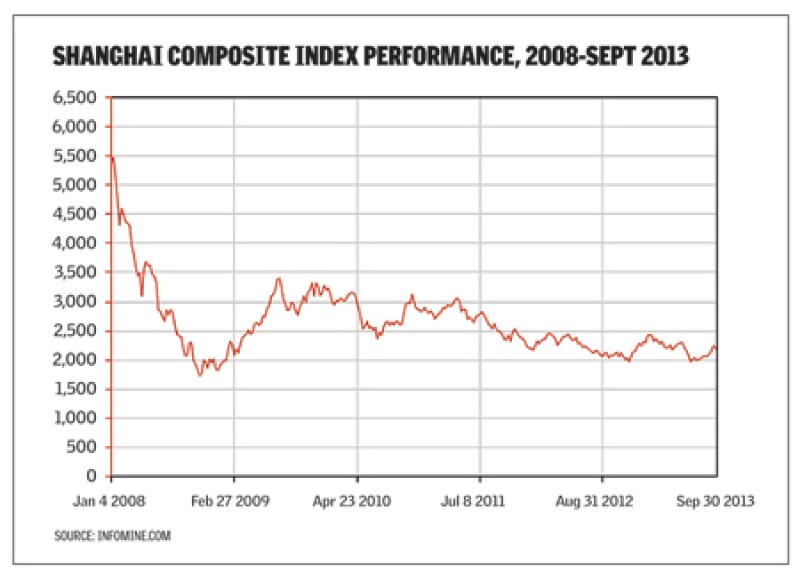
“We are 60% off all time highs, and 40% down from 2009 highs,” says Howie, referring to the CSi index which tracks the top 300 names across the two main boards. “A 10% or 20% rally over a few months makes you some money but in no way gets the market back to any significant role in the economy.”
A five-year graph of the Shanghai Composite now undeniably resembles an aircraft’s landing flight path, albeit a turbulent one. Something has to change.
Capital mis-allocation
Chinese investors require an incentive to invest for the long-term, and that appears to be lacking. The hurdle, says Rui, is that “whether it’s a state-owned firm or a private one, the Chinese stock markets don’t properly allocate capital.”
Or as Fan puts it: “There has to be long-term value to be made. But historically the China market has not rewarded long-term investment. I don’t know anyone around me who has made money using a buy and hold strategy. Even if [famous US billionaire investor] Warren Buffett came to China, I don’t think he would make money. It’s not the way the market is set up.”
Read between the lines, and the question of capital allocation becomes a far broader one, one that plays directly to Fuhrman’s point that China is a state-administered economy rather than a free-market one. Under such a system, capital allocation is to some extent determined by political motives rather than economic needs.
State-owned enterprises, often maligned as inefficient users of precious capital, are major beneficiaries, using the capital they raise to perform their mission of employing millions and thereby contributing to social stability. Companies with strong political affiliations are other favourites. And investors, alert to the benefits that state connections confer on certain companies, are willing to invest, however briefly, in those stocks, irrespective of their corporate performance. It's not an environment that rewards genuinely well-run businesses.
“Perhaps the best way to think about this is what great – not big, big is easy, great is tough – Chinese companies can you name? If there are no great Chinese companies out there then why be buying stock except for short terms moves? Over the multi-year and decade view, stocks have in no way correlated with broader economic performance,” says Howie.
Until China begins to withdraw its political domination of industry, the stock market is unlikely to start allocating capital to worthy winners. That leaves institutional and individual investors with little reason to be anything but short term or speculative, says Howie. And with many state-owned enterprises continuing to invest in non-core areas, change does not appear to be coming soon.
Looking to the long-term
Still, the CSRC is keen to at least try to get some longer-term money into the market, as witnessed by its anticipated stipulation that 40% of any future IPOs be offered to long-term investors. In the short term at least, this measure could help steady the market.
The underbelly of any such dictate is what defines long term, and the fallout for fund managers with longer mandates if retail investors bolt for the exit on any particular stock. Though China’s Social Security Fund might remain invested, Rui says, institutions with their eyes on benchmarks will be tempted to join the stampede.
“In the market, they are the minority, and they tend to follow the mainstream.”
Individual investor cynicism about Chinese institutional investors won’t help. “Most of the institutional investors are state-owned, so what assurance do people have that this will work on a market basis?” asks Fan. “What guarantee do people have that they will behave in an institutional way?”
One possible solution to market instability would be to extend market participation by foreign investment firms whose investing horizons are longer than those of domestic investors. Any such extension, however, would need to be far wider than what is now allowed under the Qualified Foreign Institutional Investor (QFII) programme. Rui estimates that foreign institutions hold no more than 5% of totally transferable shares, which has a negligible impact on market stability.
More practical would be to encourage greater participation by local private institutional fund managers. The trouble is whether such an idea would form part of the government’s wider plan for the economy. But without such a move, it’s difficult to see the current pattern of Chinese investing ever breaking.
Above all, local investors need to appreciate that buying stocks is a risky activity, and that they cannot depend on Beijing to bail them out.
“In China, investors know that a certain amount of risk will be taken care of by the government. And because they are overprotected, people have a tendency to take too much risk,” says Rui.
The CSRC – or its masters – have a lot of work to do if they want to truly fix the stock market. They need to broaden the country's investor base and reduce political domination of capital allocation, and emphasise company quality over state affiliation as the main ingredients for investment.
Do all of that and the country's bourses might become genuinely good allocators of capital to worthy companies. Rui believes that it could unleash the next wave of economic growth.
Unfortunately it's unlikely to happen. Instead, the country's stock markets will likely retain their familiar frailties when the CSRC finally allows IPOs to take place once more. Don't bank on the world's second-largest economy boasting a first-rate stock market any time soon.