

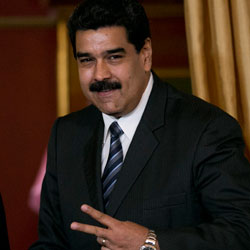
Venezuela’s political crisis continues to deepen, with President Nicolás Maduro’s refusal to send Venezuela’s 2017 budget to the National Assembly or set a date for state elections nothing short of a “self-coup”, according to Luis Nunes, a Venezuelan political scientist. “We are faced with a government that is increasingly outside the law. Maduro is disregarding the constitution at will,” Nunes told GlobalMarkets.
He said the decision was not only based on the country’s spiraling economic chaos, but also the fact that China has signaled to Maduro’s government that it was no longer willing to loan it money. China has loaned Venezuela $65bn, more than half the $125bn loaned to Latin America between 2005 and 2015, according to the Inter-American Dialogue’s China-Latin America Financial Database.
Benjamin Creutzfeldt, a postdoctoral fellow for China-Latin American-US Affairs at the SAIS Foreign Policy Institute, said China was trying to reduce its high-risk lending. “The first call to China came from countries that said ‘we need you’, but now it is coming from countries that do not want loans, but investment. China is learning from its mistakes,” he said.
The administration announced this week that it would send next year’s budget to the government-aligned Supreme Court instead of the opposition-controlled National Assembly. The move is based on an economic state of emergency, extended for another 60 days in mid-September, which allows Maduro’s administration to implement economic policies without having to consult lawmakers.
It creates yet another political impasse and adds to the country’s already dire economic mess, with the World Bank forecasting GDP to contract by 10% this year and the Institute of International Finance expecting inflation to come close to 1,000%. Reported unemployment is close to 20%.
ELECTION DELAYS
The government appointed National Election Council has also refused demands by lawmakers to set a date for the election of governors, which should be held by the end of the year. Opposition Congressman Eudoro González said it appeared that the government had no intention of holding the election, another constitutional violation.
“They don’t want Venezuelans to vote, the government knows that at this point it could not even win an election for a condominium board,” he said in a telephone interview on Thursday.
The ruling party currently holds 20 out of 23 governorships. If the December 2015 congressional elections are an indicator, the ruling party will lose heavily. Opposition parties won a super-majority in the last year’s vote, taking 112 seats in the 167-member unicameral National Assembly.
Looming over the disputes is a possible recall vote to cut short Maduro’s six-year term that ends in 2019. The Electoral Council has set October 26-28 for opponents to gather signatures from at least 20% of the electorate to force a recall.