
The choice of Riga as the venue for the 29th plenary meeting of the European Covered Bond Council (ECBC), held on April 24, was a strong signal of support for the development of the product outside its traditional homelands such as Germany and Denmark, according to the welcoming remarks from chairman Niek Allon. Riga in particular was chosen given Latvia’s role in the development of a pan-Baltic framework for covered bonds — an ambitious plan to develop a combined market for covered bonds across all three Baltic states, a point made by the Latvian finance minister Janis Reirs in his keynote speech.
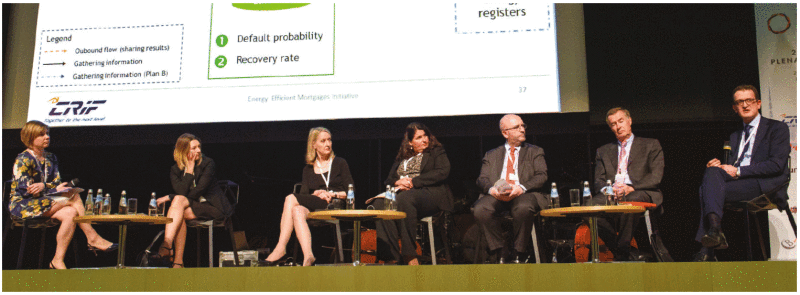
The first panel of the day, consisting of senior members of the ministries of finance of all three countries, the EBRD and Luminor (the largest bank in the region), picked up on the theme of the pan-Baltic framework and put it into the broader context of the need for the development of capital markets given the limited size of all three economies and their current over-reliance on the banking system. Pan-Baltic co-operation under a memorandum of understanding between the finance ministries of all three states is not just about covered bonds; it also covers topics as diverse as the treatment of derivatives and the inclusion of equities in a common index across the three countries. Although the idea of co-operation is straightforward, as one panellist pointed out, the devil is in the detail when it comes to co-ordinating products across different legal systems.
Charlotte Ruhe, the EBRD’s managing director with responsibility for the region, in her keynote speech, made the point that co-operation such as this should be seen in the light of the Vienna 2 initiative — a project to increase the stability of funding in countries with banking systems historically owned and funded by western European banks and thus increase the availability of credit for the real economy in particular in times of stress.
Untapped potential
The second key theme of the day was the recently enacted Covered Bond Directive, a topic introduced by Mattias Levin, deputy head of the group responsible for Capital Markets Union within the European Commission and discussed in the second panel of the day by representatives of the Commission, European Parliament and market practitioners.
The directive, according to Levin, had the dual objectives of justifying the favourable regulatory treatment that covered bonds currently enjoy under EU law and looking at ways to address the untapped potential of the product to fund the wider economy, for example by an expansion of the assets that can be used in cover pools. At the same time, as both Levin and the panellists emphasised, it was important to recognise the national specificities in current covered bond markets and the fact that the market is well functioning and survived the financial crisis with its reputation enhanced. “If it ain’t broke, why fix it?” as one panellist put it.

The implications of the directive, and other developments such as the end of quantitative easing on the market was discussed in the third panel of the day which bought together representatives of the investment banking community. The new issue market for covered bonds this year has been dominated by unexpectedly strong demand but there were divergent views expressed on both how sustainable this bull run is and the extent to which it is part of a wider fixed income market rally. The panel also considered the changes to the investor base that have occurred and the extent to which these were driven by yield levels or regulatory treatment of the bonds.
The plenary was also updated on progress in the newest covered bond market, that in Brazil. There are already over €1bn equivalent of bonds outstanding in domestic private placements in the South American country but dollar and euro deals issued to offshore investors are also expected in the near future.
Sustainable developments
The final topic of the day was the extent to which the covered bond market can aid wider societal goals such as reductions in carbon emissions and broader sustainability objectives. Covered bonds have already been used to finance many environmentally positive loans to home-owners — for example to upgrade investing housing stock’s energy efficiency rating with the development of a parallel green covered bond market. Sustainability covered bonds are at an earlier stage in their development but early signs of investor interest in the asset class are encouraging.
Mario Nava from the European Commission in a keynote speech explained some of the discussions on this topic recently in Brussels and noted the unprecedented speed with which directives have been passed to further environmental goals as the green discussion becomes less of a niche topic and more fundamental to all discussions. He called on the market to follow this lead and, as he put it, not to delegate the green topic to the last panel of the day in conferences.
The final panels of the day covered the Energy Efficient Mortgage Initative’s pilot study being conducted by the European Mortgage Federation and involving — so far — 45 banks and other lenders. In particular the efforts of the industry to demonstrate an empirical basis for preferential risk weights for mortgages with green objectives. Key themes of these panels were the need for historical data to justify the treatment and the practical difficulties of obtaining it — several IT firms are participating in the project to overcome these hurdles. The ultimate outcome, according to the initiative’s co-ordinator Luca Bertalott, is to justify lower risk weights for bank lenders, thus making it easier for them to finance loans with broader societal benefits — another way in which covered bond technology can be applied to wider societal goals.