

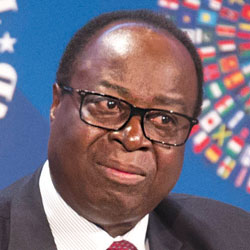
Tanzania’s relentless push to digitise, and expand, access to financial services has produced a level of inclusion unseen anywhere else in Africa, the country’s central bank governor Benno Ndulu has told Emerging Markets.
Much of the financial community still looks to Kenya as the role model for modern, accessible banking services, owing in large part to the stellar rise of M-Pesa, a phone-based money transfer and microfinance company launched there just nine years ago and now used by the vast majority of the country’s adults.
But Ndulu said Tanzania had caught up with, if not overtaken, its northern rival, and was now on course to deliver near universal financial coverage to its population.
The governor said that eight out of 10 adults in Tanzania would have access to formal financial services by next year, either through a traditional bank account or thanks to a mobile money operator. A decade ago, more than half of the population was still excluded from the financial sector, and over a quarter relied on informal forms of banking. Five years ago, when Kenya’s mobile banking sector was already booming, virtually no such transactions were taking place.
Now, things look very different, and progress is happening fast. “We are the champion of financial inclusion,” said Ndulu. “The big push is in technology.”
Because virtually all adults in Tanzania, even in remote areas, now have a mobile phone, or access to one through a friend or family member, the prospect of full inclusion is no longer a distant one.
One advantage Tanzania has over Kenya is that rather than depend on a single innovative business to expand financial coverage, it has fostered a competitive landscape, where various firms fight for a piece of the country’s unbanked population.
Ndulu said Tanzania had avoided a situation in which M-Pesa has a de facto monopoly, as in Kenya, instead ending up with five such companies — with all the advantages that brings for consumers. “As a result, the rates are lower,” he said.
And the technology is more flexible in Tanzania, too. He says: “In Kenya, if you hold an M-Pesa account and I hold an Airtel account [another mobile money operator], you have to go to an agent, get cash or buy e-units to pass the money across from one to the other. In Tanzania you can easily transfer it directly. We are the first in the world to have done this.”
That is, he says, because the Tanzanian central bank, under his impulse, has been more willing to take risks, allowing innovation to take place unregulated, then monitoring how the changes play out on the ground, and only afterwards regulating the new technology, if necessary. Most other central banks would regulate before allowing new financial services to be offered to the public, Ndulu added.
Underlying his attention to financial inclusion, and the technological means of achieving it, Ndulu, who won Emerging Markets’ Central Banker of the Year for Africa award in 2009, said: “My legacy, more than anything, is in tech.”
More than inflation reduction or any other project he has worked on, helping to guide the growth of technology has been the core pride of his tenure, he said.
Ndulu is a year away from completing his second, and final, five year mandate as governor.