Latest news
Latest news

This is the second RMBS deal from the PIF-backed issuer

Volkswagen also added a UK auto ABS to the primary

Invictus, Annaly, JP Morgan to print a billion dollars each next week






More articles
More articles
-
Expectations that the Federal Reserve will announce a third round of bond-buying this week have contributed to a rally in agency mortgage-backed securities, setting up a disruptive outcome if the Federal Open Market Committee decides Thursday meeting not to go through with QE3, Brian Lancaster, head of securitization strategy at the Royal Bank of Scotland, told SI.
-
Investec is expected to go live with its Residential Mortgage Securities 26 PLC U.K. non-conforming RMBS “imminently,” according to securitization market chatter.
-
UniCredit has launched the first ABS buyback of the autumn, using an unmodified Dutch auction to invite offers for €5bn of outstanding RMBS.
-
A bids-wanted-in-competition list comprising a diverse mix of European commercial mortgage-backed securities is due out Wednesday, as London-based ABS officials report a spike in trading of Greek residential mortgage-backed securities in recent days.
-
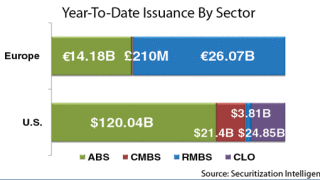
 A weekly roundup of securitization sectors with year-to-date totals in ABS, CMBS, RMBS and CLOs in the U.S. and Europe.
 -
Obvion priced its STORM 2012-IV Dutch residential mortgage securitization on Thursday afternoon, increasing the size of the bonds following strong demand from an investor pool starved of recent euro-denominated issuance and new Dutch paper in particular.
-
Bayview Mortgage Capital is tapping the private-label residential mortgage securitization market this week with its Bayview Opportunity Master Fund IIa Trust 2012-4NPL, securitizing $112 million of non-performing residential loans.
-
Investec is gauging investor appetite for a new sterling denominated deal from its Residential Mortgage Securities shelf.
-
Dutch mortgage lender Obvion completed the first public ABS deal of the autumn on Thursday, pricing its Storm 2012-4 RMBS at levels that offered generous premiums for investors and suggested that issuers may be reluctant to print too close to secondary levels.