-
A number of significant changes are under way with respect to the credit default swaps market.
-
To discuss the financial market's direction and analyze the prospects for debt financing over the next few years, we must first establish a point of reference. For me, this point is the downturn of the late 1980s and early 1990s.
-
Downgrades on U.S. floating-rate commercial mortgage-backed securities rose significantly in 2009.
-
A recent decision in the U.S. Lehman Brothers bankruptcy case held that investors in a collateralized debt obligation called Dante did not have the right to jump ahead of Lehman to get repaid, contradicting an English court decision and raising questions about how similar deals will be treated.
-
If the credit rating agencies wish to continue to seek first amendment privileges to protect their ratings, we ought to treat their assessments as simply opinions, and no more.
-
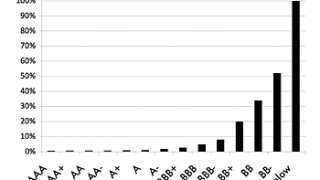
 Introduction The credit crunch has focused a lot of attention on bank capital ratios. With recent large write-downs in asset values, the implementation of Basel II's risk based capital requirements and the possible introduction of further changes following the Basel Committee's December consultation paper, banks face the prospect of holding increasing levels of regulatory capital as the assets they own deteriorate in both credit and rating quality. In particular, rating downgrades of previously highly rated structured finance assets have and will continue to result in massive increases in the amount of capital they need to hold against them (the Basel II "cliff"). Credit derivatives can be an effective tool to help banks manage these changes, and in this article we look at synthetic hedges as one way that can help achieve the goal of freeing up capital and hedging against future potential increases in capital consumption on banks' structured finance asset holdings.
 -
The latest figures to be released on the volume of Home Affordable Modification Program trial and permanent loan modifications show that through the end of November, the number of permanent modifications totals only 31,382 despite a cumulative total of 697,026 trial plans offered to borrowers in the seven months since May.
-
Co-Lender Agreements typically provide that any amounts due and payable to the master servicer or special servicer under the Pooling and Servicing Agreement of a CMBS deal with respect to the A/B loan are paid from collections on the A/B loan before the noteholders are entitled to receive payment.
-
Although we are still deep in a period of competing global and national priorities, discussions of a U.S. conversion to international financial reporting standards are again picking up -- most recently with the Securities and Exchange Commission's comments that additional clarity on its position will be forthcoming.